
Transporting dangerous goods in Queensland
You must follow state and national legal requirements if you are involved in consigning, packing, loading and transporting dangerous goods in Queensland.
The Australian Dangerous Goods Code covers national standards and requirements for transporting dangerous goods by road and rail. Queensland state laws have adopted many of the standards of the code.
Consignors are responsible for choosing and hiring a prime contractor to transport dangerous goods by road. They need to make sure goods are packed and marked correctly, tell the prime contractor the goods are classified as dangerous and give the driver a completed and accurate dangerous goods transport document.
The prime contractor is responsible for transporting dangerous goods by road and for reporting any dangerous incidents during the transport, loading or unloading of dangerous goods.
Packers, loaders, vehicle owners and drivers all have legal responsibilities to meet when handling and transporting dangerous goods.
This guide explains your legal responsibilities when involved in transporting dangerous goods and provides contact details for assistance.
What are dangerous goods?
Dangerous goods are substances and articles that have explosive, flammable, toxic, infectious or corrosive properties. They pose a risk to public safety, property or the environment.
Dangerous goods classes, divisions and packing groups
Dangerous goods substances and articles are allocated to one of 9 classes. Some of these classes are subdivided into divisions:
Class 1: Explosives
- Division 1.1: Substances and articles that have a mass explosion hazard
- Division 1.2: Substances and articles that have a projection hazard but not a mass explosion hazard
- Division 1.3: Substances and articles that have a fire hazard and either a minor blast hazard or a minor projection hazard or both, but not a mass explosion hazard
- Division 1.4: Substances and articles that present no significant hazard
- Division 1.5: Very insensitive substances that have a mass explosion hazard
- Division 1.6: Extremely insensitive articles that do not have a mass explosion hazard
Class 2: Gases
- Division 2.1: Flammable gases
- Division 2.2: Non-flammable, non-toxic gases
- Division 2.3: Toxic gases
Class 3: Flammable liquids
Class 4: Flammable solids; substances liable to spontaneous combustion; substances which, on contact with water, emit flammable gases
- Division 4.1: Flammable solids, self-reactive substances and solid desensitised explosives
- Division 4.2: Substances liable to spontaneous combustion
- Division 4.3: Substances that emit flammable gases when in contact with water
Class 5: Oxidizing substances and organic peroxides
- Division 5.1: Oxidising substances
- Division 5.2: Organic peroxides
Class 6: Toxic and infectious substances
- Division 6.1: Toxic substances
- Division 6.2: Infectious substances
Class 7: Radioactive material
Class 8: Corrosive substances
Class 9: Miscellaneous dangerous substances and articles.
Some dangerous goods fall into one of 3 packing groups depending on the degree of danger they present to people and equipment:
- Packing group I: Substances presenting high danger
- Packing group II: Substances presenting medium danger
- Packing group III: Substances presenting low danger.
The Australian Dangerous Goods Code provides more information about the classifications and divisions of dangerous goods, and if they are assigned to a packing group.
Placards and UN numbers
Each dangerous goods class is represented by a placard - a distinctive and specific class label in the shape of a diamond. For example:
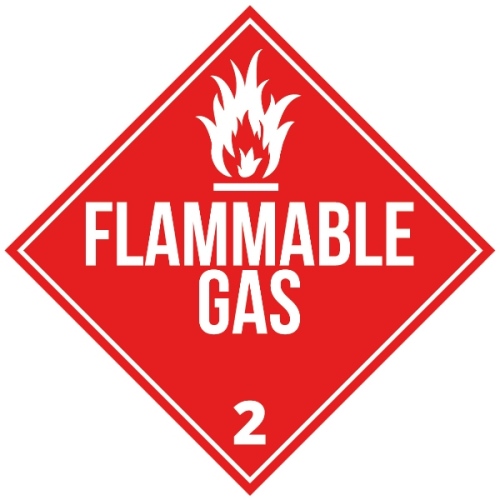
Depending on its properties, each type of dangerous goods is assigned a number known as its UN number*; for example, petrol is UN 1203. The UN number can be found on the label, transport document or safety data sheet. Otherwise the manufacturer or supplier of the goods can tell you this. You can also check if the goods are listed in the Australian Dangerous Goods Code.
*The United Nations number (UN number) is a 4-digit numbering system developed by the United Nations Committee of Experts on the Transport of Dangerous Goods for the quick identification of dangerous goods.
Interstate contacts
Contact an interstate competent authority for information on dangerous goods regulations, licensing and classifications outside of Queensland.
Transporting dangerous goods for personal or 'tools of trade' use
You may be allowed to transport by road certain quantities of dangerous goods used as 'tools of trade' or for personal use without a dangerous goods driver licence or vehicle licence. For example, a pool owner may transport pool chlorine home from the supermarket, a painter may transport paints used in the course of their business, or a salesperson may transport chemical samples as part of their job.
Even when you carry certain quantities, it is still important that you ensure packages are loaded, secured, segregated, transported and unloaded safely. The packaging also must remain fit for the purpose of transporting dangerous goods and not be altered or damaged.
The following table lists the most common dangerous goods that are used for personal use and as 'tools of trade', and can be carried in a passenger compartment or enclosed space of a passenger vehicle. You do not require a dangerous goods vehicle or driver licence to transport the items listed in this table:
Example of the dangerous goods | Dangerous goods class | Total allowable amounts |
|---|---|---|
LPG cylinders | Class 2 | No more than 50L (or 2 x 9kg bottles) |
Paint and paint products (including lacquer, enamel, stain, varnish and paint thinners) | Class 3 (Flammable liquids) | Up to 250L |
Fuel in jerry cans | Class 3 (Flammable liquids) | Up to 250L |
Waterproofing products and corrosive cleaning products | Class 8 (Corrosive substances) | Up to 250L |
Swimming pool products (including acid and chlorine) | Class 5 (Oxidising substances and Organic peroxides) | Up to 250L |
Dangerous goods carried outside the passenger compartment of a vehicle
You can transport a total quantity of dangerous goods of less than 500L or 500kg that does not include any dangerous goods from:
- United Nations (UN) division 2.1 (other than aerosols)
- UN division 2.3
- or
- packing group I (substances presenting high danger).
You can transport a total quantity of dangerous goods of less than 250L or 250kg that does include dangerous goods from:
- UN division 2.1 (other than aerosols)
- UN division 2.3*
- or
- packing group I*.
*The dangerous goods of UN division 2.3 and packing group I must together form less than 100L or 100kg of the total quantity.
Read more about dangerous goods divisions and packing groups, or review chapter 3.2 of the Australian Dangerous Goods Code for a complete list of dangerous goods.
Division 1 of the Transport Operations (Road Use Management—Dangerous Goods) Regulation 2018 contains more information about the special provisions for tools of trade and dangerous goods for private use.
Dangerous goods that must not be transported in a passenger compartment of a vehicle
Dangerous goods of classes 3, 4, 5 or 6 that together form more than 250L or 250kg of the total quantity of dangerous goods in the load, must not be transported in a passenger compartment of a vehicle or enclosed space not separated from the passenger compartment of a vehicle.
Dangerous goods of divisions 2.1, 2.3 or packing group I that together form more than 50L or 50kg of the total quantity of the dangerous goods in the load, must not be transported in a passenger compartment of a vehicle, or in any other enclosed space in a vehicle.
Read more about dangerous goods divisions and packing groups, or review chapter 3.2 of the Australian Dangerous Goods Code for a complete list of dangerous goods.
Division 1 of the Transport Operations (Road Use Management—Dangerous Goods) Regulation 2018 contains more information about the special provisions for tools of trade and dangerous goods for private use.
Transporting diesel
You don't need a dangerous goods driver licence when only transporting diesel.
In Australia, any amount of diesel transported on its own by road is not classified as a dangerous good for transport purposes.
You will need a dangerous goods driver licence when diesel is transported together with Class 3 (flammable liquids) in compartments of a multiple compartment portable tank or tank vehicle. The load then becomes a refined petroleum product dangerous good and is identified under the name of Petroleum Products (UN1270).
For more information, refer to the Australian Dangerous Goods Code, or contact the Department of Transport and Main Roads at dgu@tmr.qld.gov.au.
Interstate contacts
Contact an interstate competent authority for information on dangerous goods regulations, licensing and classifications outside of Queensland.
Duties of dangerous goods consignors
Consignors are responsible for choosing and hiring a prime contractor to transport dangerous goods by road.
As the consignor, you need to:
- make sure the goods are packed and marked appropriately
- tell the prime contractor the goods are classified as dangerous
- give the driver a completed and accurate dangerous goods transport document.
Dangerous goods transport document
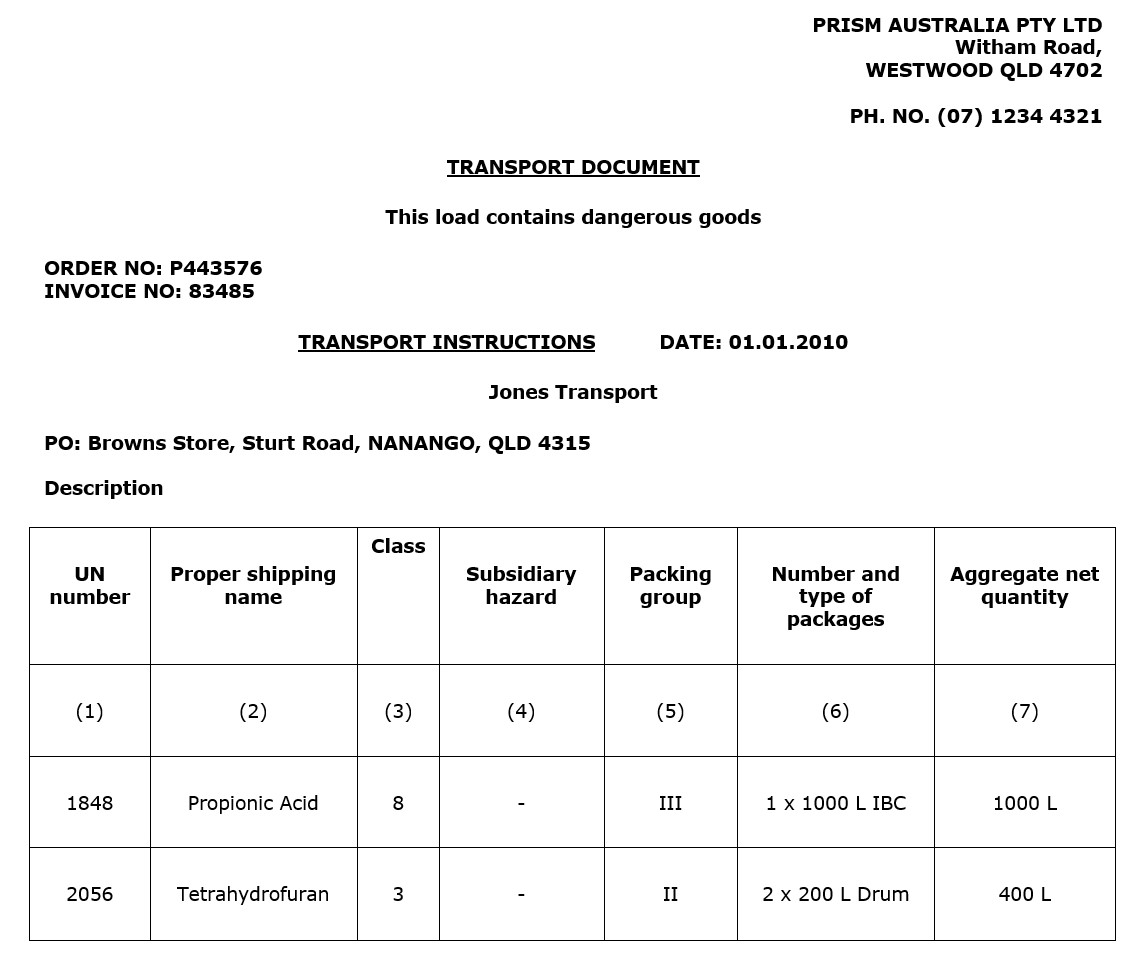
This list provides information for consignors on what they should include in each column (1-7) of a dangerous goods transport document. You can find an example dangerous goods transport document below.
Details that must be included
- The UN number* of the goods
- The proper shipping name of the goods or the name of the goods that appears on the packaging, article or other receptacle in which the goods are contained
- The class or division of the goods
- Each subsidiary hazard of the goods, if any
- The packing group for the goods, if any
- A description of each type of package or other receptacle to be transported - such as drum (DRM) or intermediate bulk container (IBC)
- The number of packages or receptacles of each type to be transported, and the aggregate quantity of the goods
Some dangerous goods of class 5.2 and class 4 have extra notification requirements. Refer to the Australian Dangerous Goods Code for more information.
*The United Nations number (UN number) is a 4-digit numbering system developed by the United Nations Committee of Experts on the Transport of Dangerous Goods for the quick identification of dangerous goods.
Example dangerous goods transport document
Placard requirements
Read about placard loads and driver and vehicle licensing requirements to determine whether a dangerous goods load must be placarded, and if a dangerous goods driver or vehicle licence is required when transporting dangerous goods by road.
Dangerous goods tank design applications
Read the guidelines for dangerous goods tank design applications to see what to include in a dangerous goods tank design application.
Interstate contacts
Contact an interstate competent authority for information on dangerous goods regulations, licensing and classifications outside of Queensland.
Also consider...
- Read about storing and transporting hazardous chemicals.
- Learn more about transporting explosives.
Duties of prime contractors when transporting dangerous goods
The prime contractor is responsible for transporting dangerous goods by road.
As the prime contractor, you must be aware of provisions in the Australian Dangerous Goods Code relating to transporting dangerous goods, including:
- safety standards
- segregation and transfer of goods
- protective and safety equipment
- travel routes
- reporting dangerous goods incidents.
You must hold at least the minimum required amount of vehicle insurance under section 221 of the Transport Operations (Road Use Management—Dangerous Goods) Regulation 2018.
Interstate contacts
Contact an interstate competent authority for information on dangerous goods regulations, licensing and classifications outside of Queensland.
Also consider...
- Read about storing and transporting hazardous chemicals.
- Learn more about transporting explosives.
Duties of packers, loaders, vehicle owners and drivers
Packers and loaders
You must not pack dangerous goods or load them into a vehicle if the packaging:
- is unsuitable, damaged, defective or not appropriately marked
- doesn't comply with the Australian Dangerous Goods Code.
You must only display the correct placard (diamond-shaped sign) for the dangerous goods being transported.
Placarding must not be false or misleading.
Vehicle owners
If you're the owner of a vehicle transporting dangerous goods, you're responsible for the vehicle's safety standards, insurance, and protective and safety equipment.
To transport dangerous goods in Queensland, your vehicle must:
- be currently registered – with your relevant state/territory authority
- have a dangerous goods vehicle licence
- meet inspection requirements.
Drivers
As the driver of a vehicle carrying dangerous goods, you must ensure that:
- you have a dangerous goods driver licence
- you carry your dangerous goods transport document at all times – issued to you from the consignor
- if a dangerous goods incident happens, you
- notify emergency services by dialling 000
- activate your transport emergency response plan and warn/advise others
- you perform your duties regarding vehicle safety standards, parking and standing, packaging and placarding
- you load, stow, restrain and segregate dangerous goods correctly
- you carry the following emergency information guides:
- Dangerous Goods – Initial Emergency Response Guide (SAA/SNZ HB 76:2010)
- or
- an emergency procedure guide for the dangerous goods transported on the vehicle (search the Intertek Inform online store for 'AS 1678') and the Emergency procedure guide – Transport – Vehicle fire (AS 1678.0.0.001-2004)
- you carry the following safety equipment
- fire extinguishers – minimum requirements are listed in Table 12.1 of the Australian Dangerous Goods Code
- personal protective and safety equipment
- 3 double-sided reflector signals.
Registered training organisations (RTOs)
Dangerous goods driver training courses are provided by approved RTOs. You must apply for a dangerous goods driver licence within 6 months of completing an approved training course.
Find a list of RTOs for the transport of dangerous goods.
Interstate drivers
All dangerous goods driver licences issued outside of Queensland allow you to drive a dangerous goods vehicle anywhere in Queensland.
Interstate contacts
Contact an interstate competent authority for information on dangerous goods regulations, licensing and classifications outside of Queensland.
Also consider...
- Read about storing and transporting hazardous chemicals.
- Learn more about transporting explosives.
Placard requirements
A vehicle carrying a dangerous goods (DG) load must be appropriately placarded in accordance with the Australian Dangerous Goods Code. This means the vehicle must display details of the dangerous goods class/division and if required, emergency information panels.
A placard is a label or emergency information panel displayed on the cargo transport unit, placardable unit or vehicle transporting dangerous goods. It can be:
- fixed to, or placed in a frame fixed to, the unit or vehicle
- stencilled or printed directly onto the unit or vehicle.
Placard load (minimum quantities)
The following 2 tables, under Table 5.3: Placard Load (Minimum Quantities) in the Australian Dangerous Goods Code, outline the placard requirements for dangerous goods loads.
A placard load is a load of dangerous goods that must be placarded under the Code's Chapter 5.3 as determined in accordance with both tables 5.3.1 and 5.3.2.
Table 5.3.1- Dangerous goods not transported under Chapter 3.4
Dangerous goods in a cargo transport unit | Placard load quantity and licensing requirements |
|---|---|
(a) Dangerous goods in a receptacle with a:
Receptacles are containment vessels for receiving and holding substances or articles, including any means of closing | A placard is required for 1 or more such receptacles - for example, 1 or more placardable units A dangerous goods driver and vehicle licence is required |
(b) Includes any quantity of:
| Aggregate quantity of all dangerous goods (other than limited quantities (LQ) in the cargo transport unit is equal to or greater than 250kg or 250L (see Note 5) No dangerous goods vehicle or driver licence is required |
(c) Division 6.2 (infectious substances) – category A | A placard is required for all quantities No dangerous goods vehicle or driver licence is required |
(d) Division 6.2 (infectious substances) – other than category A | A placard is required for more than or equal to 10kg or 10L No dangerous goods vehicle or driver licence is required |
(e) Loads where (a) – (d) do not apply | Aggregate quantity of dangerous goods (other than LQ) is equal to or greater than 1,000kg or 1,000L (see Note 5), unless the load is a Fumigated Unit (UN 3359 – see Note 3) No dangerous goods vehicle or driver licence is required |
Table 5.3.2 – Dangerous goods transported under Chapter 3.4
Dangerous goods packed in limited quantities and/or domestic consumable dangerous goods.
Note: These placarding thresholds are separate to and in addition to the above placarding thresholds. In practice, this may mean a single vehicle is required to be placarded with both a placard for the fully regulated DG in the load and an LQ placard.
| Dangerous goods in a cargo transport unit | Placard load quantity and licensing requirements |
|---|---|
| (f) Limited quantities dangerous goods and/or domestic consumable dangerous goods (defined in section 1.2.1 of the Australian Dangerous Goods Code) | The load includes limited quantities dangerous goods and/or domestic consumable dangerous goods that includes an aggregate quantity of any one UN number from a single place of consignment of equal to or greater than 2,000kg or 2,000L |
(g) Loads where (f) does not apply limited quantities dangerous goods and/or domestic consumable dangerous goods (defined in section 1.2.1 of the Australian Dangerous Goods Code) | The gross mass of the limited quantities dangerous goods and/or domestic consumable dangerous goods is equal to or greater than 8 tonnes (see Note 5) |
Note 1: For placarding quantities of Class 1 (explosives), refer to the Australian Explosives Code. Contact Resources Safety & Health Queensland for more information.
Note 2: For placarding quantities of Class 7 (radioactive material), refer to the Code of Practice for the Safe Transport of Radioactive Substances. Contact Queensland Health for further information.
Note 3: A Fumigated Unit (UN 3359) complying with Chapter 5.5 of the Australian Dangerous Goods Code that does not contain any other dangerous goods is not a placard load, and should not be included in the total quantity of dangerous goods when determining a placard load.
Note 4: For land transport wholly within Australia, this Code requires placards to be displayed on cargo transport units if they contain a placard load, as determined from Table 5.3. It should be noted that cargo transport units containing lesser quantities may need to be placarded in accordance with the IMDG Code before they are acceptable for transport by sea, even within Australian waters.
Note 5: When transporting a load that contains dangerous goods specified in (b) or (e) of Table 5.3.1 and dangerous goods specified in (g) of Table 5.3.2, each of which are below a placard load, the combined quantity of dangerous goods in the load must be calculated and the result assessed against the relevant threshold in Table 5.3.1.
Calculation of combined quantity
- If the relevant threshold for the dangerous goods in Table 5.3.1 is (b) - the combined quantity = the aggregate qty regulated DG + 10% of the gross weight of the LQ/DC
- or
- If the relevant threshold for the dangerous goods in Table 5.3.1 is (e) - the combined quantity = the aggregate qty regulated DG + 25% of the gross weight of the LQ/DC
For more information contact the Department of Transport and Main Roads at dgu@tmr.qld.gov.au.
Interstate contacts
Contact an interstate competent authority for information on dangerous goods regulations, licensing and classifications outside of Queensland.
Dangerous goods tank design compliance statement templates
If you will be transporting dangerous goods in a tank—either forming part of the vehicle, or attached to the vehicle – you need to have the tank design approved by the Department of Transport and Main Roads before it can be used for the transport of dangerous goods by road.
When applying, you will need to include a cover letter and the relevant compliance statement. Templates are available in both Word and Excel format.
To learn about the application process or which Australian Standards apply for a dangerous goods tanker, visit dangerous goods tank design applications.
Fee
The application fee is $312.45 (current to 30 June 2026). You must pay the fee at a transport and motoring customer service centre prior to posting your application.
Note: On 1 July 2025 our fees and charges increased by 3.4% in line with the government's indexation policy.
Application checklist
Dangerous goods tank design applications must include:
- a cover letter—use the dangerous goods tank design application cover letter and ensure all fields are completed in full
- application fee receipt—include a scanned copy with your application (payable at any transport and motoring customer service centre)
- a design application statement that addresses every applicable clause of the relevant standards (2 copies for posted applications and 1 copy for emailed applications)
- a compliance statement template of the relevant standards. Ensure all fields are completed in full. (1 copy for posted and emailed applications)
- layout drawings of the vehicle, with the tank attached—submit drawings which outline the required measurements for compliance to the applicable standards, e.g. road and cabin to tank clearances and stability measurements. (2&nsbp;copies for posted applications and 1 copy for emailed applications)
- approval notice and approval number issued by Workplace Health and Safety Queensland (WHSQ)—for applications involving pressure vessels, where the pressure vessel has been approved to AS1210 or other applicable standards. (2 copies for posted applications and 1 copy for emailed applications)
- the signature of a Registered Practising Engineer in Queensland* (RPEQ) on every page of the application.
* The Board of Professional Engineers of Queensland administers the Queensland Professional Engineers Act 2002 and prohibits persons who are not registered from providing professional engineering services in Queensland.
Design Application statements
The design application statements are prepared by the RPEQ engineer and must clearly outline how the design achieves compliance and, where relevant, reference supplied drawings, details, calculations and photographs. The information supplied must be comprehensive and satisfy the department that the design is safe for transporting dangerous goods.
Where a clause in the standard is for information purposes – such as scope and definitions – the engineer should write 'understood, read and noted' or 'understood, responsibility of owner' (or similar). Similarly, if a clause in the standard is not relevant to the application, the engineer should write 'understood, not relevant to this design'.
The following table is an example of an acceptable design application statement:
Clause no. | Clause description | Comments | Person - ID | Reference specifications/drawings |
|---|---|---|---|---|
2.1 | Basic design | Understood, see below | J Done – Engineer | |
2.1.1 | Stability | Understood, read and requirements met. See drawing and calculations | J Done – Engineer | Drawing No. 123XY and stability calculation |
2.1.2 | Road clearance | Understood, read and requirements met. See drawing | J Done – Engineer | Drawing No. 124YX |
2.2 | Trailers and semitrailers | Understood, read and requirements met | J Done – Engineer |
Drawings
All drawings must contain enough detailed information to support claims of compliance against the relevant standards. All notes, dimensions and figures must be able to be read without magnification.
You must clearly identify symbols in an appropriate legend on each drawing, and every drawing must be signed and dated by a RPEQ engineer certifying compliance.
You must include an overall layout drawing with the application, as well as other drawings outlining specific details (for example, method of tank attachment). This overall layout drawing must show the fully configured vehicle including the location of fire extinguishers, placards and emergency stop buttons.
The drawing must also show the:
- ground clearance to the lowest tank component
- cabin to tank clearance
- impact protection distance from the rear of the tank to impact surface and stability variables (width and height from the ground to centroid of tank).
Refer to the relevant standards for a complete list of the variables that you need to show in the drawings. Your application may be delayed if you don't include all the information required.
You may include photographs in your application to show the design and prove compliance.
Australian Standards
The following Australian Standards outline the specifications for design, construction, testing, maintenance and inspection of road tank vehicles (as referenced in chapter 6.9 of the Australian Dangerous Goods Code).
Standard | Type of dangerous goods |
|---|---|
AS2809 – Part 1 | Part 1 applies to all road tank vehicles, in addition to the requirements of the applicable Part 2-6 according to the type of goods |
AS2809 – Part 2 | Flammable liquids |
AS2809 – Part 3 | Liquefied compressed gases |
AS2809 – Part 4 | Toxic or corrosive liquids. The correct type of tank (1–5) under this part should be selected according to the properties of the dangerous goods to be transported |
AS2809 – Part 5 | Bitumen-based products |
AS2809 – Part 6 | Cryogenic gases and liquids |
These Australian Standards can be purchased from SAI Global.
Compliance statement templates
Download a compliance statement template for each relevant standard.
Submitting your application
Send your application to: dgu@tmr.qld.gov.au
Email submissions preferred. If you are submitting your application by mail, ensure you have 2 full copies of your application and post to:
Industry Licensing — Industry Accreditation Policy Unit
Department of Transport and Main Roads
PO Box 673
FORTITUDE VALLEY QLD 4006
Approval process and guidelines
Approval of a tank design by the department only applies to use of the vehicle in Queensland. If the road tank vehicle will be used in other states, make this known in your application. The approval will then be submitted to the Competent Authorities Panel (CAP) for national endorsement, which will allow the use of the vehicle in other states.
You may manufacture multiple units of the same approved design (differentiating individual units by the manufacturer's serial number). However, if any changes are made to the department's approved design, you must submit a new tank design application to the department, along with the required fee.
Similarly, you must submit a new tank design application, along with the required fee, to the department, if a tank is removed from a road tank vehicle that has an existing tank design approval and fitted to another vehicle (known as 're-horsing').
For more information about the application process or which Australian Standards apply for a dangerous goods tanker, contact the Department of Transport and Main Roads at dgu@tmr.qld.gov.au.
Data and Resources
- Dangerous goods tank design application cover letter (DOCX, 81KB)
- Dangerous goods tank design compliance statement AS2809–Part 1 (DOCX, 93KB)
- Dangerous goods tank design compliance statement AS2809–Part 2 (DOCX, 93KB)
- Dangerous goods tank design compliance statement AS2809–Part 3 DOCX, 94KB)
- Dangerous goods tank design compliance statement AS2809–Part 4 DOCX, 93KB)
- Dangerous goods tank design compliance statement AS2809–Part 5 DOCX, 94KB)
Dangerous goods packaging design applications
If you will be transporting dangerous goods in packaging, you need to have the packaging design approved by the Department of Transport and Main Roads before it can be used for the transport of dangerous goods by road. Examples of packaging include:
- intermediate bulk containers
- outer packaging
- drums
- jerry cans
- boxes
- bottles
- bags.
Fee
The application fee is $62.55 (current to 30 June 2026). You must pay the fee at a transport and motoring customer service centre prior to posting your application.
Note: On 1 July 2025 our fees and charges increased by 3.4% in line with the government's indexation policy.
Application checklist
Dangerous goods packaging design applications must include:
- a cover letter explaining the purpose of the application
- a copy of the application fee receipt (payable at any transport and motoring customer service centre)
- a National Association of Testing Authorities (NATA) Certificate of Test (package performance test). It must address the applicable clauses required for packaging from the Australian Dangerous Goods Code. You must include diagrams of the packaging.
Submitting your application
Send your application to:
Industry and Operator Authorisation Unit
Department of Transport and Main Roads
PO Box 673
FORTITUDE VALLEY QLD 4006
or
Email your application to dgu@tmr.qld.gov.au.
Approval process and guidelines
Approval of a packaging design by the department only applies to use of the packaging in Queensland. If the packaging will be used in other states and territories, make this known in your application. The approval will then be submitted to the Competent Authorities Panel (CAP) for national endorsement, which will allow the use of the packaging in other states and territories.
You may manufacture multiple units of the same packaging design. However, if any changes are made to the approved design, you must submit a new packaging design application, along with the application fee.
For more information about the application process for dangerous goods packaging, contact the department at dgu@tmr.qld.gov.au.
Reporting dangerous goods incidents
When a dangerous goods incident results in a dangerous situation, the prime contractor must advise the Department of Transport and Main Roads (TMR) and provide details and written reports.
A dangerous situation may occur during the transport, loading or unloading of dangerous goods. You must report any incident as dangerous if it can cause, or is likely to cause, an imminent risk of:
- death or injury to a person
- harm to the environment
- damage to property.
Reporting within 24 hours
As the driver or the prime contractor of the vehicle, you must tell us about a dangerous goods incident within 24 hours of the incident.
Send your initial report about:
- road incidents to dgu@tmr.qld.gov.au
- rail incidents to railsafety@tmr.qld.gov.au.
You must include in your initial report:
- the nature of the incident
- where and when the incident happened
- what dangerous goods were being transported.
Reporting within 21 days
As the prime contractor (transporting dangerous goods by road) or rail operator (transporting dangerous goods by rail), you must provide TMR with a detailed written report within 21 days of the incident.
Prime contractors must use the Dangerous goods incident report form and rail operators must sent the report to railsafety@tmr.qld.gov.au.
Your detailed written report should include:
- the nature of the incident
- where and when the incident happened
- what dangerous goods were being transported
- what the driver of the vehicle thinks caused the incident
- what the prime contractor thinks caused the incident
- any measures taken to control any fire, explosion leak, spill or escape of dangerous goods
- any measures taken after the incident in relation to the dangerous goods
- any measures taken to prevent the incident from reoccurring.
Interstate contacts
Contact an interstate competent authority for information on dangerous goods regulations, licensing and classifications outside of Queensland.
Also consider...
- Read about storing and transporting hazardous chemicals.
- Learn more about transporting explosives.
Road and rail laws for dangerous goods
The Australian Dangerous Goods Code provides the national standards and requirements for transporting dangerous goods by both road and rail.
Queensland's dangerous goods laws
The code should be read in combination with Queensland's state laws, which have adopted many standards of the code.
Queensland's road and rail transport laws regulate the transportation of dangerous goods.
Road transport laws
- Transport Operations (Road Use Management) Act 1995
- Transport Operations (Road Use Management—Dangerous Goods) Regulation 2018
Rail transport laws
- Transport Infrastructure Act 1994
Chapter 14 – Transporting dangerous goods by rail - Transport Infrastructure (Dangerous Goods by Rail) Regulation 2018
National exemptions, approvals or administrative determinations
The Competent Authorities Panel (CAP) considers submissions requesting national exemptions, determinations and classifications that may operate differently to the current edition of the Australian Dangerous Goods Code.
In Queensland, submissions to the CAP must first be considered by the Department of Transport and Main Roads to ensure that the matter is of national effect and the submission is complete and in accordance with the regulations.
Download and complete the CAP submissions pro-forma and send to the Department of Transport and Main Roads with supporting information such as diagrams, photographic material and other technical information.
Email dgu@tmr.qld.gov.au or read the CAP guide for applicants for more information.
Find out more
Transporting by road
For more information on the laws for transporting dangerous goods by road, you can contact the Department of Transport and Main Roads by:
- emailing dgu@tmr.qld.gov.au
- writing to
Industry and Operator Authorisation Unit
Department of Transport and Main Roads
PO Box 673
FORTITUDE VALLEY QLD 4006
Transporting by rail
For more information on the laws for transporting dangerous goods by rail, you can contact the Department of Transport and Main Roads by:
- emailing railsafety@tmr.qld.gov.au
- writing to
Rail Safety Policy Unit
GPO Box 2595
BRISBANE QLD 4001
Transporting dangerous cargo by water
Find port procedure manuals for information about transporting dangerous cargo in Queensland waters.
Interstate contacts
Contact an interstate competent authority for information on dangerous goods regulations, licensing and classifications outside of Queensland.
Also consider...
- Read about storing and transporting hazardous chemicals.
- Learn more about transporting explosives.
Transporting dangerous goods by road
Under the Australian Dangerous Goods Code, a prime contractor and driver of a road vehicle transporting dangerous goods has an obligation to:
- plan safe dangerous goods routes by road
- observe all the requirements/restrictions on selection of routes, or times of travel, as determined by the regulator (Department of Transport and Main Roads).
General principles for safe route selection
- Try to use freeways, highways or other major roads.
- Avoid town centres, central business districts and known congested routes (particularly at times of peak activity).
- Avoid shopping centres, schools and health care facilities during peak hours.
- Avoid residential areas.
- Avoid tunnels.
Select major roads
When transporting dangerous goods it is a good idea to use major roads/corridors as much as possible.
The most appropriate routes for transporting dangerous goods will change from time to time, due to changes in the condition of the road network and roadworks etc.
Avoid heavily populated/congested areas
Avoiding heavily populated or congested areas is particularly applicable when transporting toxic gases, or dangerous goods that may release toxic gases in the event of a spill or a fire.
For the bulk transfer of dangerous goods, especially fuel, avoid congested service stations during peak hours.
Avoid water catchment areas and environmentally sensitive zones
Avoid routes that pass through surface water catchment areas. Public drinking water source areas and environmentally sensitive areas may be particularly vulnerable to vehicles carrying toxic Division 6.1 or Class 9 dangerous goods.
Avoid underground water protection areas, water catchment areas for potable water and sensitive environmental zones.
Avoid tunnels and restricted routes
When planning dangerous goods routes, tunnels or others sensitive road infrastructure should be avoided.
Placard loads of dangerous goods (including explosives) must not be driven through tunnels where a Placard Load Prohibited Sign exists – penalties apply.
Observe relevant road signs
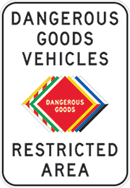
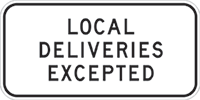
These special road signs mark the preferred routes and guide dangerous goods drivers around Brisbane.
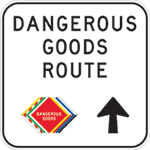
Transporting dangerous goods by road in the Metropolitan Brisbane Area
Read the Transport of dangerous goods by roads restrictions flyer for key principles/considerations in designing and maintaining safe dangerous goods routes in the Metropolitan Brisbane Area.
Dangerous goods vehicle drivers should only depart from these routes to make local deliveries.
© The State of Queensland 1995–2026