
Paper mulberry
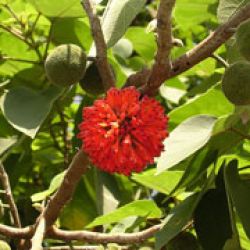
Paper mulberry flowers
© Wikimedia Creative Commons
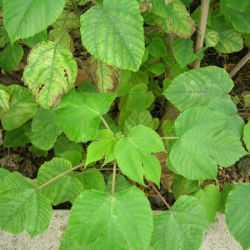
Paper mulberry leaves
© F & K Starr Creative Commons
Native to Asia, paper mulberry is a small, quick-growing tree with red to orange fruit. It can form dense thickets that replace other vegetation.
Paper mulberry is a significant pest in several countries, including Pakistan and Argentina, where it ranks among the worst invasive plant species. In Queensland, paper mulberry is only sparingly naturalised around Brisbane and the coastal Wet Tropics, but could become a significant long-term problem if its spread is not controlled.
Scientific name
Broussonetia papyrifera
Description
- Quick-growing shrub or small tree up to 15m tall.
- Leaves are simple, alternate, 8–20cm long, sandpaper-textured, with milky sap that stains clothes.
- Flowers are yellowish white, arranged in elongated inflorescence up to 8cm long.
- Fruits are red to orange-yellow, sweet, 1–4cm in diameter.
Habitat
- Prefers open, disturbed habitats in coastal, tropical and subtropical high-rainfall areas.
- Can also invade less disturbed sites along riverbanks and in semi-deciduous, low-growing forests.
Distribution
- Sparingly naturalised in Queensland.
- Has potential to spread over much larger areas.
Life cycle
- Fruits are produced twice each year.
- Seeds rarely germinate under dense forest canopies, but germination can be prolific in large canopy gaps, roadsides and abandoned farmland.
Plants affected
- Native plants
- pasture
Impacts
Environmental
- Forms dense thickets, replacing native vegetation in coastal, high-rainfall areas.
Economic
- Thickets may possibly replace pasture in coastal, high-rainfall areas.
How it is spread
- Seeds dispersed by bats and birds that consume fruit.
Prevention
Control
Herbicide control
- No herbicide is currently registered for control of paper mulberry in Queensland. An off-label use permit (permit no. PER11463) allows use of various herbicides to control invasive plants in non-agricultural areas, bushland, forests, wetlands, and coastal and adjacent areas.
- Read the paper mulberry fact sheet to learn about herbicide control and application rates.
Legal requirements
- Paper mulberry is a category 3 and 5 restricted invasive plant under the Biosecurity Act 2014. You must not:
- keep it
- give it away
- sell it
- release it into the environment.
If you do any of these, penalties may apply.
- You must take all reasonable and practical measures that are under your control to minimise the biosecurity risks associated with dealing with paper mulberry. This is part of your general biosecurity obligation.
- Each local government agency must have a biosecurity plan that covers invasive plants in its area. This plan may include actions to be taken on paper mulberry. Some of these actions may be required under local laws. Contact your local government for more information.
Further information
- Contact us online, by phone or in person.
- Read the paper mulberry fact sheet.
- Find out more from the paper mulberry risk assessment (PDF, 655KB).