
Climate resilience in the Logan Basin water plan area
There have been many updates to weather patterns, forecast models and climate data since the current Logan Basin water plan was established in 2007.
We have reviewed if and how water availability has changed since 2007.
Technical assessments have been done to evaluate the risk of climate variability to water availability in the plan area.
Learn how we manage climate variability risks.
Queensland’s water plans in a variable and changing climate report (PDF, 19.0MB) identifies climate impacts across each of the water plan areas.
For example, pages 56 and 57 show the below snapshot of observed and projected climate trends for the Logan Basin water plan area. This snapshot includes 2 scenarios represented by a representative concentration pathway (RCP) of 8.5 (high greenhouse gas emissions) and 4.5 (lower greenhouse gas emissions) for the years 2030 and 2050. They indicate:
- average daily temperatures are projected to increase between 1.0 and 1.7 degrees centigrade
- average annual rainfall could increase by 2% by 2030 but return to no change (0%) by 2050 under the high emissions scenario
- average annual potential evapotranspiration (PET) is projected to increase between 5% and 15%.
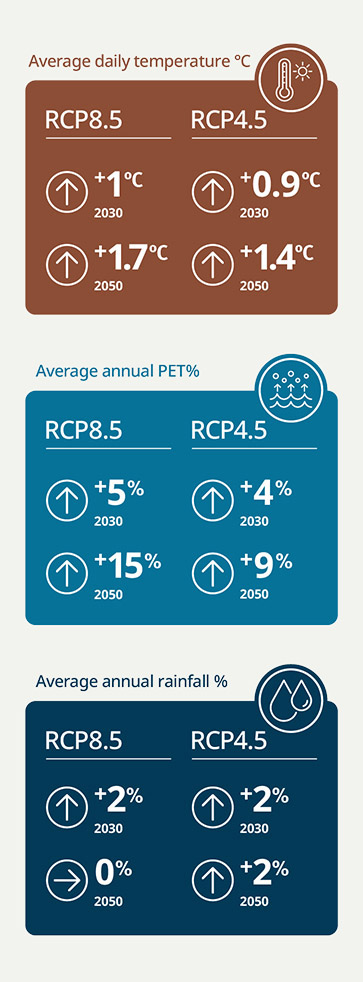
Observed and projected climate trends in the Logan Basin water plan area