Carbon farming in Australia
What is carbon farming?
Carbon farming is a new industry, with the Australian Carbon Credit a new commodity, much like beef or wool. The Emissions Reduction Fund and other investors in carbon projects have already supported hundreds of projects across Queensland that are benefiting our regions through more diversified income streams for land holders, as well as a healthier environment and more resilient ecosystems.
Carbon farming is about a change in your land management to either avoid the emissions of greenhouse gases from your activities, or to change your activities to increase the storage of carbon in the land either in trees or soil.
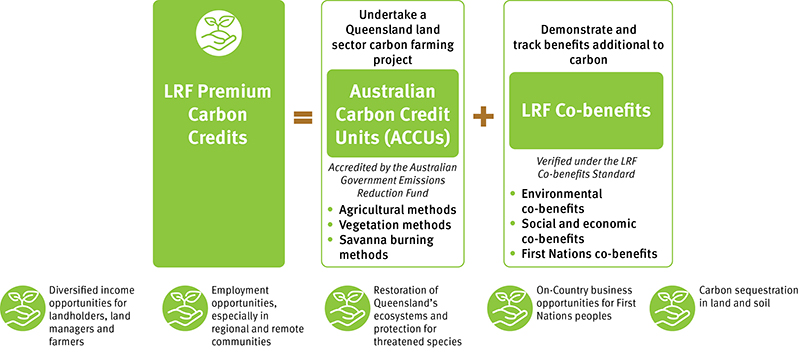
Activities within carbon farming fall into two broad groups, either emissions avoidance or sequestration, although some methods involve a bit of both. The key thing is that to earn Australian Carbon Credit Units, you need to use a method that’s registered and available for use under the Emissions Reduction Fund. Those methods fall into three broad classes that are eligible for Land Restoration Fund projects. They are agricultural methods, vegetation methods and savanna burning methods.
Agricultural methods are about a change in your management of your beef herd or your cropping system to reduce the amount of nitrous oxide or methane that’s emitted to the atmosphere, as they are both potent greenhouse gases. Agricultural methods can also be a change in the way you manage your pasture or soil to increase the storage of carbon in your soil.
Vegetation methods are primarily about regrowing native vegetation. That can involve either Human-induced Regeneration of Native Forests, which for example can be achieved through a change in grazing management or a cessation of clearing practices, but they can also involve direct planting of native species in what are called Environmental Planting projects.
Savanna burning methods are fundamentally about reducing the extent of really hot fires that occur in the late dry season in our tropics. Those hot fires release a lot of methane and nitrous oxide and consume more of the fuel than cooler fires that are lit earlier in the dry season.
Deciding which method is suitable for you requires independent advice and consideration of how it fits within your enterprise. You can use tools like CSIRO’s LOOC-C to get a sense of the amount of carbon credits you can earn through particular methods and seek that advice from financial, legal and carbon farming experts to really get to understand what’s required under each of the sixteen methods that are available for Land Restoration Fund projects, and understand what the implications of undertaking carbon farming activities will be for your business.
An Australian Carbon Credit Unit represents one ton of carbon dioxide equivalent greenhouse gases either avoided in terms of not being emitted to the atmosphere or being taken from the atmosphere and stored in carbon sinks, like vegetation or soil. We refer to them as ACCUs.
An ACCU is a financial product that can be earned through carbon farming projects registered with the Clean Energy Regulator. Once they’ve been earned, they can be sold or kept for sale later, either to the Commonwealth Government, the Land Restoration Fund, or the broader secondary market.
The number Australian Carbon Credit Units that you’ll be able to generate on your property depends on the method that you’ll use, as well as where you are and what’s happened on that land in the past. They also change in terms of the number of ACCUs you generate per unit area per year through time. For example, a forest will generate a fairly small number of ACCUs when the trees are very young and then the number of ACCUs being generated per year will increase as the forest matures.
Thinking about the financial impact of a carbon farming project requires more than just thinking about the ACCUs. You also need to think about the cost of implementing the activity required for the carbon farming projects. Those activities are land management activities as well as the monitoring and reporting activities required to verify the carbon and co-benefit outcomes for the LRF.
Another consideration is the opportunity cost. Where you reintroduce a forest to your land that you may have been using for grazing, that may impact the grazing potential of that land into the future. Carbon farming projects are often long-term projects and that’s why we suggest you take financial and legal advice, as well as carbon farming advice, when you’re considering entering into the carbon farming industry.
For more information on selecting the right carbon farming method for you, and how to value and design projects for the Land Restoration Fund, visit the Land Restoration Fund website.
Greenhouse gases in our atmosphere help to regulate the Earth’s temperature by trapping the sun’s heat and keeping it from radiating back into space. Increasing levels of greenhouse gases like carbon dioxide and methane act like extra blankets, warming the Earth and changing the climate.
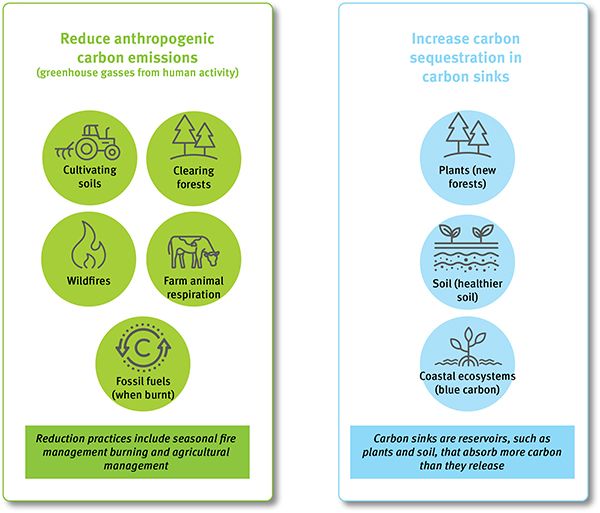
Human activity – such as burning fossilised carbon (fossil fuels) and deforestation for land development – has tipped the balance of the carbon cycle. When fossil fuels are burned, or land is cleared, carbon dioxide is released into the air. Trees and other parts of our environment can reabsorb some of the extra carbon dioxide, but the capacity for the Earth to do this is limited.
Carbon farming presents an opportunity to help restore balance, using Earth’s land-based plant life and wetlands to naturally reabsorb excess carbon dioxide, or changing land management practices to reduce the amount of greenhouse gases emitted from human activities.
Carbon farming land management activities seek to:
- Reduce anthropogenic carbon emissions
- Increase carbon sequestration in carbon sinks
Carbon farming can also provide landholders with a range of benefits such as increased natural capital and an alternate source of income. Benefits could include:
- improved water use efficiency
- better protection for stock (through natural shade and windbreaks)
- improved livestock production
- increasing habitat for threatened species
- improved soil quality
- improved fertiliser-use efficiency.
Read about the carbon farming opportunities available in different regions of Queensland.
Queensland’s carbon farming future
In 2015, the global community came together to create the Paris Climate Agreement (Agreement), a landmark voluntary global agreement to combat climate change.
As part of the Agreement, each signatory country set their own Nationally Determined Contribution or emissions reduction target, and carbon markets are one of the primary tools that are being used to reduce carbon emissions and meet targets.
In response to the Agreement, Australia set a target of reducing its emissions by 43% below 2005 levels by 2030. Read more about Australia's emissions projections here.
The Queensland Government has set a greenhouse gas emissions reduction target of 75% by 2035. Read more about Queensland’s emissions data.
Due to its size and diverse natural ecology, Queensland is well positioned to generate carbon credits through carbon farming.
As the global economy shifts towards a low emissions future, emitters are looking for new and secure supplies of credits to offset their carbon impact. Important economic sectors in Queensland, such as mining, agriculture, and tourism are already transforming their practices to reduce emissions and minimise their environmental impact.
Many Queensland landholders are already earning an income from carbon projects. Check the map to see where carbon projects registered with the Clean Energy Regulator are occurring in Queensland. Alternatively, carbon credits can be retained by landholders and surrendered to offset on-farm emissions.
Carbon farming key concepts
There are several key concepts that all landholders should be familiar with when considering undertaking a carbon farming project. Please refer to the Clean Energy Regulator for detailed information. All Land Restoration Fund (LRF) projects must also abide by these requirements.
Newness and additionality
For a project to be eligible for registration with the ACCU Scheme, it must:
- Not have started before it is registered with the Clean Energy Regulator (newness requirement)
- Not be required by a Commonwealth, state or territory law (regulatory additionality requirement)
- Not likely to be carried out in the absence of the ACCU Scheme framework.
Legal right
Having the legal right to carry out a carbon farming project means that the project proponent has:
- The right to carry out the project activities on or for the sites or assets identified in the project
- A lawful and exclusive right to be issued the ACCUs that may be created as a result of the project.
Eligible interest holder consent
For land-sector projects, the project proponent must obtain the consent of any persons or organisations that have an eligible interest in the land on which the project will take place. Examples of eligible interest holders include:
- native title interest holders
- mortgagors
- lessors, including the state in the case of Queensland leasehold land
The Clean Energy Regulator provides detailed information on eligible interest holder consent, including specific guidance on native title and eligible interest holder consent.
Permanence periods
All sequestration projects are subject to ‘permanence periods’. This is the time taken to ‘permanently’ remove carbon from the atmosphere and store it in vegetation and soils. It provides assurance that an ACCU issued from a sequestration is genuine and ‘real’.
Under the ACCU Scheme, there are two permanence periods of 100 and 25 years. Once a project is registered with a nominated permanence period, that permanence period cannot be changed at a later time.
If a landholder nominates a 25-year permanence period, there will be a 20 percent reduction in the number of ACCUs issued for that project in addition to the five percent risk of reversal buffer.
The Clean Energy Regulator provides detailed information on permanence obligations.
Read more about how to get started with designing and registering a carbon farming project.