Public moorings and no anchoring areas
Protecting coral
Queensland marine parks are home to abundant and diverse marine life, attracting thousands of visitors each year. Corals are among the most popular attractions, yet they are the most vulnerable.
Coral reefs can be damaged by:
- a vessel’s anchor and chain dropping or dragging on coral
- a vessel grounding when the wind changes or the tide ebbs
- a chain or rope wrapping around coral or breaking pieces off.
It may take many years for coral to recover. Some coral never returns to its original condition. By taking a little extra care when anchoring, and using public moorings where available, you will help protect this delicate underwater landscape.
Public moorings
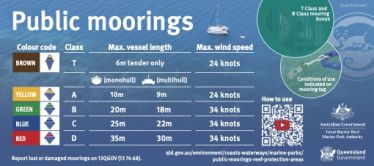
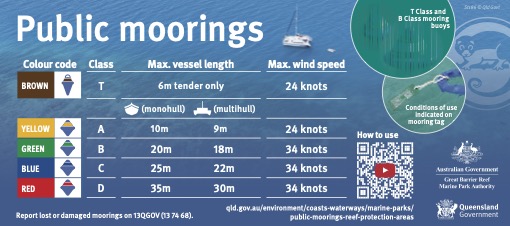
Public moorings are installed at popular locations and have blue, cone shaped buoys with a colour-coded band. This band tells you the class (vessel length), time limits and maximum wind strength limits that apply to the mooring. Mooring specifications and conditions of use are also displayed on the mooring tag attached to the pick-up line.
When using moorings be aware that:
- public moorings are available to all recreational and commercial users
- all public moorings are available for overnight use
- all public moorings have a time limit on day use. A vessel cannot occupy a mooring for longer that the time limit specified on the mooring tag between the hours of 7am and 5pm. Moorings may have a two, four or 24-hour limit. This ensures fair and equitable use. If a vessel picks up a mooring with a two or four-hour limit, on or after 3pm, it may remain until 9am the next day
- public moorings must not be used by more than one craft at a time (ancillary craft exempted), unless otherwise stated
- care should be taken to comply with all information displayed on the mooring tag
- it is an offence to remove, misuse or engage in conduct that results in damage to a public mooring.
If you have found a damaged mooring or a buoy that has come adrift, please make a note of any markings, its GPS position and report it on 13QGOV (13 74 68).
| Mooring class | Vessel size limit | Mooring colour band | Max design wind speed |
|---|---|---|---|
| T | 6 metres | Brown | 24 knots |
| A | Monohull 10 metres or Cat 9 metres | Yellow | 24 knots |
| B | Monohull 20 metres or Cat 18 metres | Green | 34 knots (up to gale warning) |
| C | Monohull 25 metres or Cat 22 metres | Blue | 34 knots (up to gale warning)/ 24 knots Moreton |
| D | Monohull 35 metres or Cat 30 metres | Red | 34 knots (up to gale warning) |
No anchoring areas
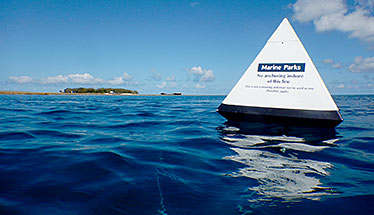
Marine parks in Queensland contain many well-developed fringing reefs that are particularly vulnerable to anchor damage. To protect these highly diverse coral communities, there are no anchoring areas where anchoring is not allowed.
Reef protection markers have been installed to mark the no-anchoring areas. The markers are easily identified by their white, pyramid-shaped buoys with a blue label (joined with an imaginary line).
No-anchoring areas in state Marine Parks are defined (unless indicated otherwise) by placing two or more reef protection markers in a way such that the no-anchoring area is the area formed by the following lines:
(a) the lines made by joining each of the reef protection markers; and
- (i) if the reef protection markers are installed at a fringing reef- the lines that run from each end of the line of reef protection markers mentioned in paragraph (a) and then extend to the closest point of low water at each end of the line; and
- (ii) the line that runs along low water between the lines mentioned in paragraph (i).
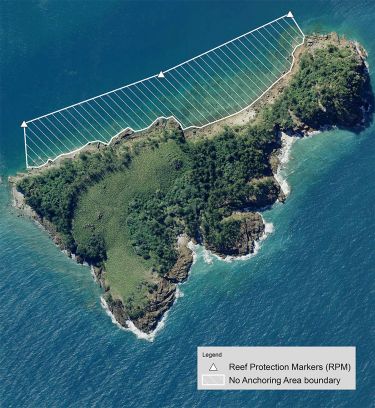
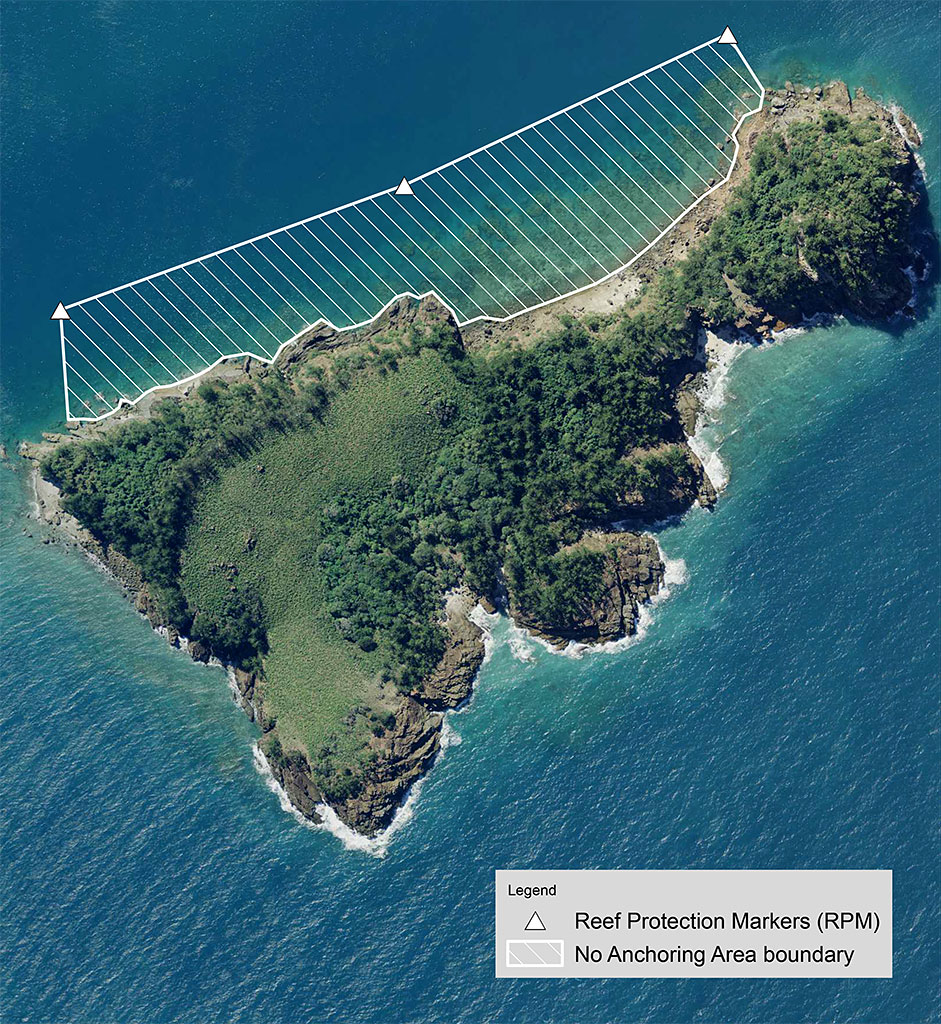
Never anchor on the reef flat inshore of the buoys. You can anchor directly on the beach provided there are no tidal restrictions. Please note that reef protection markers are not strong enough to moor vessels and should not be used as a mooring.
The Qld Fishing 2.0 app allows you to view Public Moorings and Reef Protection Markers (no anchoring areas). It is available for both mobile phones and tablets and can be downloaded from Google Play and the Apple Store.
To access the Qld Fishing 2.0 app layers, simply click on 'Can I fish here?'.
Public moorings and responsible anchoring - Protecting coral in the Great Barrier Reef
(Voice 1)
So – you’re heading out boating on the Great Barrier Reef? Well I’ve got some good news to make sure you have the best time.
(Voice 2)
Did you know that the Great Barrier Reef has a system of public moorings and reef protection markers? These protect areas of delicate coral and other sensitive habitats from being damaged by anchors.
(Voice 1)
Public moorings are in place along the Great Barrier Reef coastline from the Keppel Islands in the south right up to iconic Lizard Island and the Cod Hole in the north. Whether you are heading out to the reef or islands on your own boat, or renting a bareboat to cruise the beautiful Whitsunday Islands in style, this video aims to give you some tips and tricks to ensure the reef is protected from anchor damage.
(Voice 2)
Public moorings are available for any boaties to use, and on a first-come-first served basis. So get in early and make sure you tie up on the correct mooring. Depending on the size of your boat, different types of public moorings are available to use. Here’s what you need to know.
(Voice 1)
You can identify public moorings by the blue plastic float, usually with a coloured band of information on the buoy and a plastic tag detailing important information about the mooring. Remember that tying up a bigger boat on a mooring intended for smaller boats creates a risk of grounding or pulling the mooring system out.
If you have a small boat – up to 6m long - like a smaller trailer boat, tinny or tender, all public mooring are safe to use.
But it’s best to use the small tender moorings. These moorings have a much smaller blue buoy than the others and also a brown information tag. They are usually placed close to the reef edge in shallow waters, or close to the shore. They allow easy access to the reef edge for snorkelling or close access to island campgrounds and walking tracks.
If you have a boat between 6 and 10m long – use the moorings with a yellow band.
For those cruising boats and bareboats between 10 and 20m use the green band moorings.
Other boats including larger commercial tourism vessels up to 25m should use the blue banded moorings, and the red banded moorings are for vessels up to 35m in length.
(Voice 2)
While it’s not safe to use a mooring that is intended for vessels smaller than yours, it is OK - and safe - to use a mooring intended for vessels larger than yours. However, if a bigger vessel approaches, they might not have as many options as you do. Please be considerate of this and leave the blue and red moorings free for larger vessels when appropriate.
(Voice 1)
When approaching to pick up a mooring, motor up into the conditions – so into the wind or current - very slowly and being careful to not run over the pickup line. Use a boat hook to retrieve the pick-up line. If the pick-up line loop fits over the cleat or bollard on your bow - great - you can pop it straight on. If you need to however, you can use a smaller line running from your cleat through the eye of the pickup line and back onto the cleat to secure the pickup line. This is also a sensible technique to use if there is a chance the weather might turn quickly and you need to leave the mooring in a hurry. It is important to keep this line quite short however, as anything longer may increase the swing circle of the vessel, resulting in grounding or reef damage.
You’ll see on the mooring tag that there is a time limit indicated – they are usually 2 hours, 4 hours or may be up to 24 hours. The time limit is to try to ensure equitable use – particularly at busy sites.
(Voice 2)
For all moorings though, if you pick up the mooring on or after 3 in the afternoon, you are welcome to stay overnight until 9 the next morning. The tag may also have other important information about the mooring written on it too – take the time to read it and understand any other conditions of use written on the tag. Penalties may apply to the misuse of moorings.
When you leave the mooring, motor ahead gently just to slacken the tension on the lines. Drop the line well clear of your vessel and reverse away from the mooring line and buoy. Be aware of where the line is at all times while maneuvering so you don’t accidentally run over it while turning around.
(Voice 1)
White pyramid shaped marker buoys are also in place at many locations. These are reef protection markers - and when joined with an imaginary line they designate a no-anchoring area to protect delicate fringing reefs from anchor damage. They are also a good visual reference to understand where the edge of the shallow reef is. Anchoring is not allowed inshore of the line of buoys - penalties may apply. However, you are allowed to traverse this area to get to the beach, or enter the area without anchoring.
(Voice 2)
If you are going in to the beach inside a line of reef protection markers, you can anchor your boat on the beach – though of course be aware of what the tide is doing – you don’t want to be stuck high and dry!
The anchoring system for reef protection markers is not designed to hold the weight of a boat like a mooring is. Don’t try to moor your boat onto a reef protection marker, as you will likely pull it out or drag it causing damage.
(Voice 1)
If you need to anchor, anchor outside the line of reef protection markers and try to find a sandy or muddy patch, away from coral. Use enough anchor chain and line for the water depth and conditions.
When pulling up anchor, motor towards it. If the anchor is stuck, motor the vessel above the anchor and slightly ahead, before pulling it up.
(Voice 2)
Obviously though, if public moorings are provided and available, they are a far easier option. We’ve provided them for you to enjoy the beauty of the Great Barrier Reef more easily while protecting what you have come to experience and enjoy.
If you’d like to know more about the system of public moorings and reef protection markers in place along the Great Barrier Reef, look out for these free brochures and check out the website.
(Voice 1)
You’ll find heaps of downloadable maps, including GPS locations of all public moorings. This way you’ll stay safe and enjoy your time out on the water!