Marine pests
Marine pests are introduced invasive, non-native plants and animals that cause damage to the health of the native marine environment.
About marine pests
Marine pests often reproduce quickly, in large numbers and can spread rapidly.
Once established, they are difficult to eradicate and can:
- kill or out-compete native plants and animals for space and food
- damage boat hulls, increase drag and fuel costs, and foul marine structures leading to increased maintenance costs
- impact widely on marine industries including ports and marinas, the commercial and recreational fishing industry and can lead to boating and fishing restrictions in affected areas.
Queensland has 3 established marine pests, but protecting Queensland’s marine ecosystems from additional pests should still be a priority for anyone who uses or enjoys the marine environment.
Shared responsibility
Biosecurity is a shared responsibility, which is why Biosecurity Queensland is asking users of Queensland’s marine environment to watch for and report suspected marine pests.
This will help protect Queensland’s marine biodiversity and minimise the risk of pests establishing in Queensland’s marine environment.
The most effective way to minimise the impact of marine pests is to prevent them from arriving. Early detection and response is the best chance we have to successfully contain and manage marine pests and protect our marine environment, key marine industries including, ports, marinas, commercial fisheries, tourism and aquaculture and our way of life.
Invasive and introduced marine species
Eight invasive pest species with the highest chance of arriving and establishing in Queensland waters have been identified:
- Asian green mussel (Perna viridis)
- Black striped false mussel (Mytilopsis sallei)
- Asian bag mussel (Arcuatula senhousia)
- Brown mussel (Perna perna)
- Charru mussel (Mytella strigata)
- Harris mud crab (Rhithropanopeus harrisii)
- Chinese mitten crab (Eriocheir sinensis)
- Japanese seaweed/Wakame (Undaria pinnatifida)
Three introduced marine pest species are established in Queensland waters:
- White colonial sea squirt (Didemnum perlucidum)
- Black scar oyster (Magallana bilineata)
- Suminoe oyster (Magallana ariakensis)
Monitoring and reporting
Take these steps to do your bit to report suspected marine pests before they spread.
Step 1
Look around and keep an eye out. If you see or suspect a marine pest, report it.
Step 2
If you see a suspected marine pest:
- take a photo of the suspect marine plant or animal
- collect a sample if it is safe to do so. Biosecurity Queensland can advise you on how to collect, pack and send samples but generally:
- place the sample in a plastic container or bag such as a sandwich zip lock bag
- store the sample in the refrigerator or keep it on ice (do not freeze)
- contact Biosecurity Queensland on 13 25 23 about how to package a specific sample and where to send it for identification.
- Report the marine pest sighting online or phone 13 25 23.
Step 3
Don’t introduce or spread pests. Marine pests can unknowingly be attached to your boat or in a ship’s ballast and be transported long distances. Surveillance and good maintenance will help minimise the threat.
What you can do
Be aware of possible marine pests
- Keep a guide handy to identify marine pests (PDF, 2.8MB) when cleaning your boat and when out in the marine environment.
Check your boat for fouling regularly
- Clean your boat regularly, preferably in a dry dock or slipway, and when moving between locations.
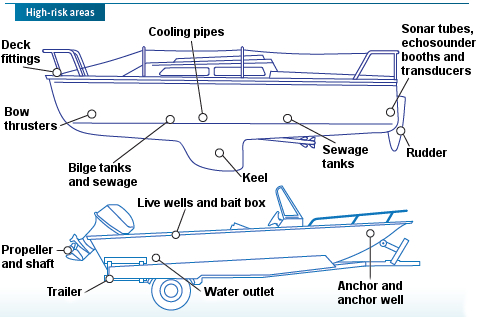
- Look out for pests, paying attention to high-risk areas:
- deck fittings
- bow thrusters
- bilge tanks and sewage
- cooling pipes
- keel
- sewage tanks
- rudder
- sonar tubes, echosounder booths and transducers
- propeller and shaft
- trailer
- water outlet
- live wells and bait box
- anchor and anchor well.
- Flush internal seawater systems regularly with freshwater or use an approved treatment.
Dispose of waste responsibly
- Remove marine fouling growing on the boat and treat it as a potential biosecurity risk.
- Safely dispose of marine fouling in an onshore rubbish bin.
- Seafood and bait from non-local areas should be disposed of in an onshore rubbish bin.
Inspect and clean equipment and gear
- Before moving to a different location, inspect, clean and dry marine equipment and gear including pots, nets, fishing or diving gear, anchors and ropes.
- If possible, dry your equipment for at least 48 hours before using it in a different area.
Apply antifouling paint to your boat
- Apply antifouling paint correctly and as required by the manufacturer.
- Keep a record in a log book of all work done to your boat.
In-water cleaning
Cleaning of boats in the water should only be undertaken when cleaning of the vessel out of the water is not operationally practicable, and only when removal of biofouling:
- does not harm the anti-fouling coating
- presents an acceptable biosecurity or contaminant risk as determined by the authorities.
In Queensland, the relevant authorities are Biosecurity Queensland and the Department of the Environment, Tourism, Science and Innovation.
Check advice in the Australian Government’s anti-fouling and in-water cleaning guidelines on when in-water cleaning may be acceptable.
Contact Biosecurity Queensland on 13 25 23 and DETSI on 13 74 68 for notification and approval processes.
More information and resources
- Download the Queensland marine pest and disease guide (PDF, 2.8MB).
- Read Australian Government information on marine pests.
- Download the printable material below:
- Watch these videos on marine pests:
Everyone has a part to play to protect Queensland’s marine environment from introduced marine pests.
There are things that can be done to reduce the establishment of marine pests in Queensland.
by keeping an eye out when you’re out in the water and by cleaning our boats regularly.
Marine pests like to attach to marine structures and boat hulls.
So when you’re cleaning your boat pay particular attention to the nooks that marine pests might like to hitch a ride in.
And if you see anything suspicious please, REPORT it to Biosecurity Queensland on 13 25 23
And remember:
LOOK
REPORT
PROTECT
Female:
Keeping Queensland’s marine environment healthy and pest free is vital to our way of life and to our marine industries including commercial fishing, ports and marinas and tourism.
Everyone has a part to play to help protect Queensland’s marine environment from introduced marine pests.
They can kill or outcompete native plants and animals for space and food and can be destructive to marine structures and boats.
Male:
Marine pests might not look like much but these guys can be invasive and fast growing, they can be transported across the ocean on hulls of vessels and in ballast water, once they arrive they can attach to the hulls of local boats and marine structures.
The good news is we can help prevent the spread of marine pests simply by cleaning our boats regularly and paying close attention to all the nooks and crannies in which they like to hide.
It’s important to clean and inspect below the water line of your boat, especially, the propeller and shaft, the rudder, the anchor and anchor well, all water inlets and outlets and any other through-hole fittings bow thrusters, anodes, deck fittings and any other nooks and crannies they might get into, and don’t forget, any other related items including boat trailers and burley buckets.
It’s a good idea to keep your marine pest ID guide handy, to get a copy of this guide contact Biosecurity Queensland or visit the DAF website.
Female:
If you see a suspected marine pest, report it to Biosecurity Queensland as soon as you can, take a photo, and if possible keep a sample for identification if it is safe to do so.
And of course if you remove a suspected marine pest, don’t throw it back into the water.
Look around and keep an eye out for suspected marine pests and if you see anything suspicious, please report it as soon as you can to Biosecurity Queensland. Do your bit to help protect Queensland waters, marine industries and our way of life.
Remember, look , report, protect.
Contact us
- Use our online form to report a marine pest
- Email us at marinepests@dpi.qld.gov.au
- Contact us online or by phone.