State colour and emblems
Part of the State flag, emblems and icons topic
Learn about Queensland's official colour and emblems, why they were chosen and their significance to state identity. Our emblems are recognised in the Emblems of Queensland Act 2005.
On this page
State colour

On 13 November 2003 the Governor in Council officially named maroon as Queensland's state colour. Maroon is a deep red colour with purple undertones.
This declaration was made as a result of a long-held, but informal, tradition of using maroon to represent Queensland.
Maroon has traditionally been associated with sport in Queensland. The Brisbane Broncos (rugby league) and the Brisbane Lions (AFL) sporting clubs both use shades of maroon in their team colours (in combination with gold for the Broncos and blue and gold for the Lions).
Though a particular shade of maroon has been declared, Queenslanders wear many shades of maroon at sport and other public events to show their state spirit and identify themselves as Queenslanders.
Colour specifications for print and digital media
Coated: Pantone® 202c
Uncoated: Pantone® 201u
Process (coated stocks): C-0%, M-100%, Y-65%, K-47%
Process (uncoated stocks): C-0%, M-100%, Y-65%, K-34%
Web friendly hexadecimal colour: #73182C
RGB: R-115, G-24, B-44
State gem
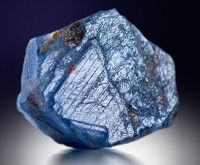 The sapphire was named the official state gem for Queensland in August 1985.
The sapphire gemstone is a variety of the mineral corundum, The hardness of the sapphire is second only to that of the diamond. It was originally discovered in central Queensland in the early 1870s and can still be found in central and northern parts of the state.
A typical corundum is very dark in colour when found in nature, with tinges of blue, green or brown and is nearly opaque, More transparent varieties display a wide range of colours, from yellow and gold to purple.
The name sapphire (Aluminium Oxide) was traditionally used for clear, blue corundum stones. Today, except for the pink varieties called rubies, it's common to refer to stones of all colours as sapphires.
The pink to red colour of a ruby is caused by its chromium content, yellow and green sapphires contain variable amounts of ferrous and ferric iron, and the sapphire's blue is due to its titanium content.
Floral emblem
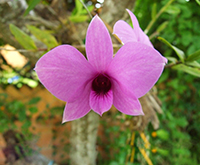 The Cooktown orchid became Queensland's floral emblem in 1959, during celebrations to mark the state's centenary.
Before this, the distinctive native flower had long been popularly considered Queensland's unofficial floral emblem. This was according to a government-sponsored newspaper public opinion poll taken in the centenary year. The State Parliament endorsed the popular choice in the now repealed Badge, Arms, Floral and Other Emblems of Queensland Act 1959.
The orchid was commemorated in 1968 on the 25-cent stamp and more recently in 1998, on the $1.20 stamp.
About the Cooktown orchid
The Cooktown orchid (Dendrobium bigibbum) is native to Queensland's northern tropics and is named after the northern Queensland town of Cooktown. It grows on trees and rocks in well-watered areas of the Cape York Peninsula.
Each plant flowers for up to 6 weeks in autumn and winter, with individual flowers reaching between 3cm and 6cm in width. The Cooktown orchid is usually purple in colour, although varieties with white or white-spotted flowers have also been found.
Animal emblem
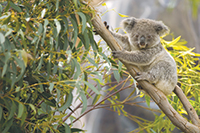 The koala was officially named the animal (faunal) emblem of Queensland in 1971, after a newspaper poll showed strong public support for this endearing marsupial. The Queensland Government introduced the poll due to a proposal by state tourism ministers for all states to adopt a faunal emblem.
About the koala
The koala (Phascolarctos cinereus) is commonly located throughout eastern areas of Queensland, south of Townsville, although it has been found as far north as Cooktown and as far west as Cunnamulla.
A popular and renowned icon, the species is known to be shy. However, colonies of koalas often thrive near built-up areas if there is sufficient bushland to provide a suitable habitat.
The koala is a marsupial – an animal that carries its young in a pouch. The newborn, less than two centimetres long, crawls through its mother's fur to her pouch, where it is harboured and suckled for about six months.
Normally a gentle creature, the koala spends almost all of its life in the tops of eucalyptus trees, usually dozing during the day and actively foraging for choice leaves at night.
As the species rarely drinks water, the name 'koala' originates from the Indigenous word meaning 'no drink', since it usually gains adequate moisture from dew and oily eucalyptus leaves.
Bird emblem
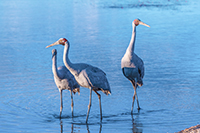 The brolga has featured on the Queensland Coat of Arms since 1977. It wasn't until January 1986 that it was announced as the official bird emblem of Queensland.
About the brolga
Of the 14 species that comprise a worldwide family of cranes, brolgas (Grus rubicunda) are the only species native to Australia. Also known as the Native Companions, they can be found in grasslands and swamps along the Queensland coast, from Rockhampton to the Gulf of Carpentaria.
Adult birds are predominantly grey and are characterised by a long thin neck, a bare head and a prominent patch of red skin behind the eye. They stand more than a metre tall on long, slender legs and their outstretched wings can measure up to 2 metres across.
Brolgas are famous for their intricate dancing at mating time. A pair of adult birds will bow to each other with exaggerated dignity, then bob and pirouette and prance back and forth. Sometimes they will jump into the air in unison. Their huge wings are spread throughout the dance, adding extraordinary grace and smoothness to the movements.
Aquatic emblem
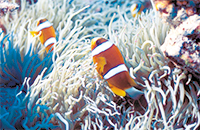 The Barrier Reef Anemone Fish was officially named as Queensland's aquatic emblem in March 2005.
Queensland is renowned for its association with the coastline and the water, and so it's only fitting that an official emblem symbolises this.
The Australian Underwater Federation originally developed the idea to introduce an official aquatic emblem for Queensland. As a result, a panel of experts, chaired by the Queensland Museum, suggested a shortlist of aquatic species.
The public were then invited to have their say on the shortlist during an 8-week consultation process and nominated the Anemone Fish as their preferred representative for Queensland.
About the Anemone Fish
The Anemone Fish (Amphiprion akindynos) is well known for its habit of living with large, tropical sea anemones. The species name, akindynos, comes from the Greek word meaning safe or without danger. This refers to the condition the fish enjoys while tucked among the tentacles of its host.
The species grows to 12cm in length and has a brown-orange colour with 2 white bars surrounded by black edging. The first bar crosses the head, the second crosses the body at the middle of the dorsal fin and the tail is of a pure white colour.
Image ©Great Barrier Reef Marine Park Authority
Fossil emblem
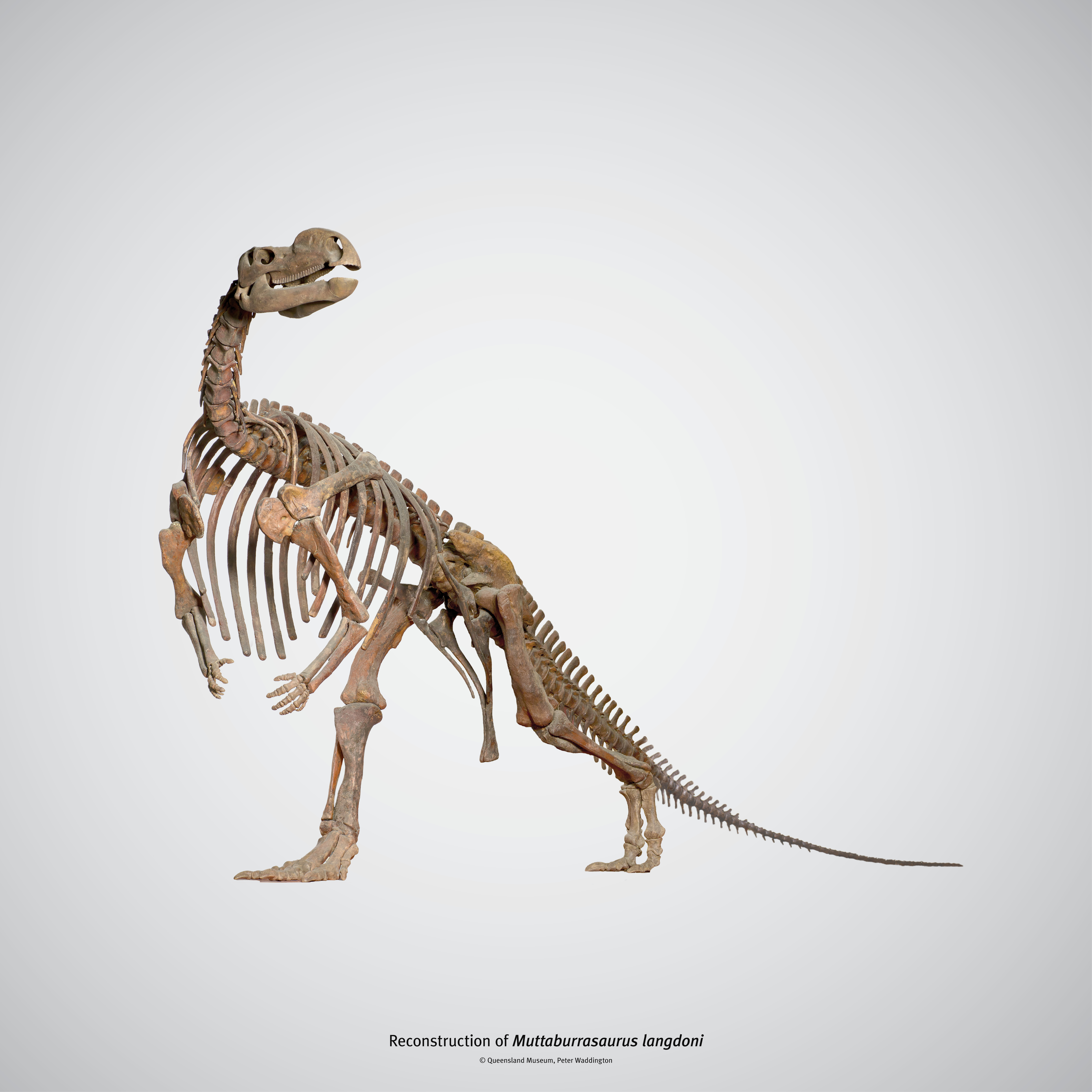
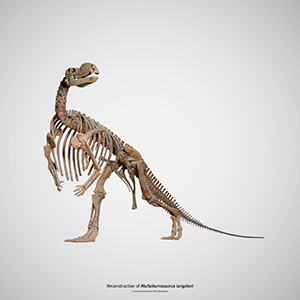 The Muttaburrasaurus langdoni was officially recognised as Queensland’s fossil emblem in December 2023.
The search for a fossil emblem began after the Winton community petitioned the Queensland Parliament in 2020 for the Diamantinasaurus matildae to become Queensland's official fossil emblem. In early 2021, the Queensland Government began a process to identify a shortlist of potential fossils for the first State fossil emblem.
From April 2022 to July 2022, coinciding with the dinosaur tourism season, Queenslanders were invited to have their say online, and nominate their favourite state fossil emblem from 12 candidates. Among these choices, Muttaburrasaurus langdoni emerged as the clear favourite of Queenslanders.
Use of the fossil emblem image
The reconstructed Muttaburrasaurus langdoni image is available for download, under the Creative Commons CC BY-NC-ND 4.0 license.
The image can only be used for educational, informational, or personal purposes. Commercial use, such as for promotions or profit, is not allowed. Additionally, the image and its caption ('Reconstruction of Muttaburrasaurus langdoni ©Queensland Museum, Peter Waddington') must not be altered and must be used in its original form as per the licence.
For more information or inquiries about the use of the Muttaburra dinosaur image, contact the Queensland Museum.
You may be interested in
Managed by: Department of the Premier and Cabinet