Organ donation for kidney transplantation
Transplantation relies entirely on the goodwill and generosity of Organ and Tissue donors and their families. Find out more about organ donation.
Organ and Tissue donors across Australia and New Zealand are cared for through Donate Life. The Queensland Donate Life staff are based at Princess Alexandra Hospital in Brisbane.
Deceased Donor Transplantation
Most kidney transplants come from people who have died in hospital, and whose family have consented to the organs being donated for the specific purpose of transplantation. This type of organ donation is known as deceased donor transplantation. Your doctor cannot tell you about the donor or where your kidney has come from. The history of the donor is carefully checked and tests are done before the organ is transplanted to exclude illnesses in the donor that could be passed on (such as infections like hepatitis B and C and HIV).
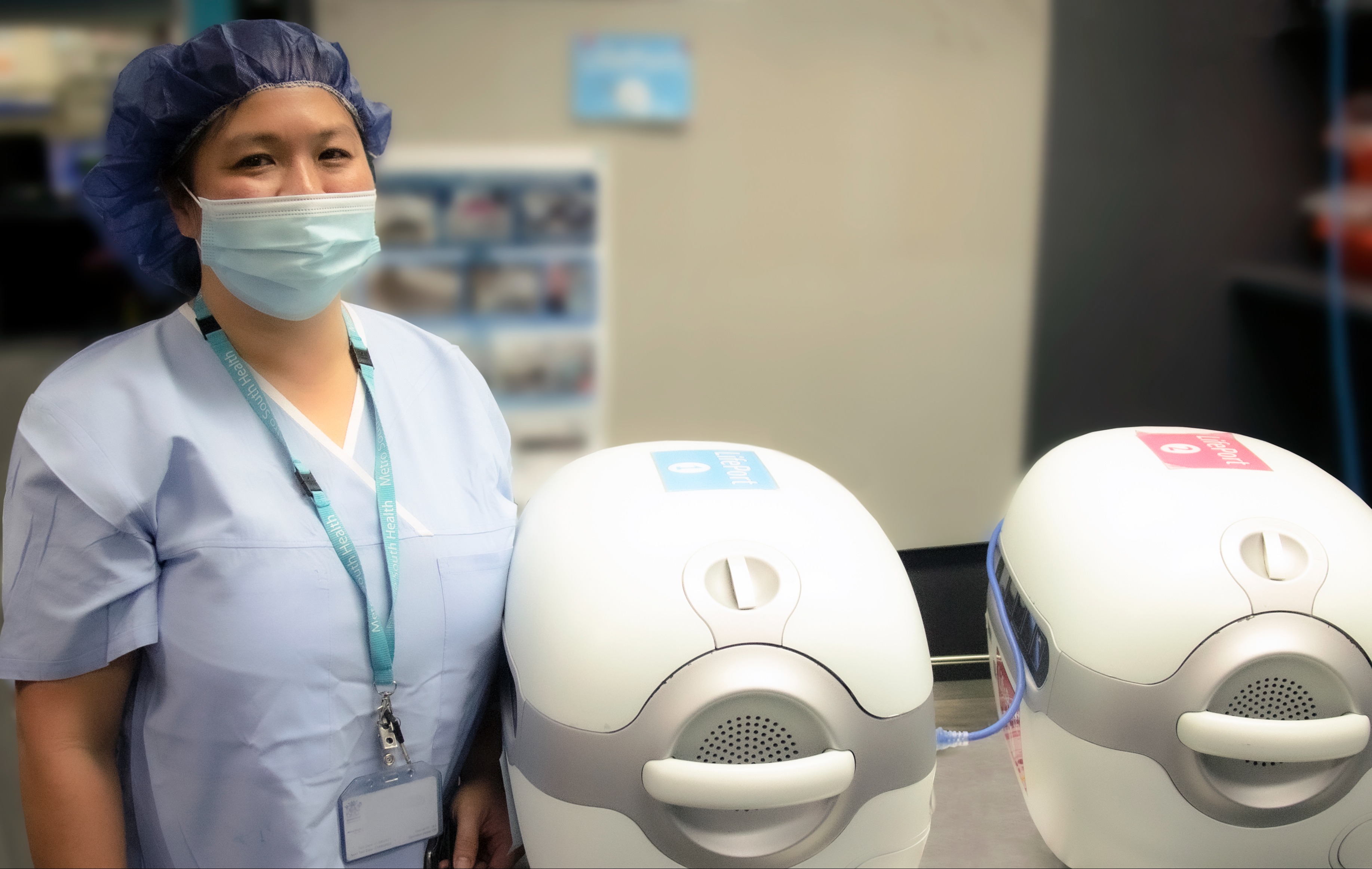 The kidneys are removed in an operating theatre and are flushed with a preserving solution through the blood vessels supplying the kidney and placed in a cold solution. This allows the kidneys to be transported to the PAH and allow time for a recipient to arrive in the ward and be prepared for theatre to receive the transplant kidney.
Kidneys can survive for up to 30 hours outside the body, but in general we try and proceed with the transplant as soon as possible.
One of the recent advances has been the use of the ‘lifeport box’ in which the kidney is placed in a box and cold fluid is pumped through the blood vessels allowing a longer time between retrieval of the kidney and the transplant operation.
Living Kidney Donation
A significant number of kidneys are donated by family and friends of people with or approaching end-stage kidney failure. Providing the donor is in good health, with 2 normal kidneys and no extra risks for developing future kidney failure, donating a kidney is a safe procedure. Typically, donors move from having a lower risk of future kidney failure to about the same risk as the general population.
All living donors will have a “work up” that is a very detailed assessment by the 'team' that includes transplant assessment coordinators, physicians, surgeons, psychiatrists and social workers. This usually takes at least 3 months. The assessment looks closely at the risks both in the short and long term and requires a number of tests and medical visits. It is very important that donors have regular medical follow-up for the rest of their life to check their blood pressure and kidney function.
For the recipient, having a living kidney donor has several advantages. The waiting time for the transplant can be shorter and the transplant can sometimes be done before you need to start dialysis (pre-emptive transplantation). The operation can be planned for a time that is suitable for the donor, recipient and transplant team. The quality of the kidney is known and there is a better chance that the kidney will work straight away. On average, kidneys from living donors last longer.
Improved immunosuppressive medication and treatments that remove blood group antibodies, now allow donors and recipients with incompatible blood groups to have very successful transplants. Transplantation of genetically unrelated living donors is very successful. This includes spouses and friends, who may not be related by blood but share a close emotional link with the patient. More information is available in the Blood Group Incompatible (ABOi) Kidney Transplants Brochure 314.3 KB) .
Some donor and recipient pairs remain 'incompatible' despite the best available technology. These patients may benefit from participation in the Australian and New Zealand Paired Kidney Exchange Programme (ANZKX). Patients may contact either their kidney specialist(Nephrologist) or the transplant assessment coordinator at PAH for additional details.
Contact between donor families and transplant recipients
Donor families and transplant recipients can write anonymous letters to each other through DonateLife Agencies and through transplant units. By law, health professionals involved in donation and transplantation must keep the identity of donors and recipients anonymous.
All transplant recipients are strongly encouraged to write to their donor families. This allows the recipient to acknowledge and thank the donor family for their decision to donate their loved one’s organs, and to describe the impact the transplant has had upon their life. It means a lot to the donor family.
As a transplant recipient you may like to write a letter or card to your donor's family to thank them or acknowledge their life-changing or life-saving gift.
This video aims to provide you, as a transplant recipient, with more information about how to do this and to recognize the feelings and emotions that can be experienced by recipients during this time.
It is important to know that there is no time limit for writing to your donors family.
You can write when you feel ready which may be shortly after your surgery or many years later.
Only you will know when the time is right for you.
Many transplant recipients have said they struggle in writing to their donors family so please know you're not alone if you experience this.
Your transplant coordinator can assist you if you're having trouble and more information about what to include will be covered later in this video.
Most donor families love to hear from their loved ones recipients.
Receiving a card or a note of thanks can provide them with a sense of comfort knowing that the donation has helped others and that their gift was truly appreciated.
My mom was ... She was beautiful and I know we all say that about our mums but we had a closeness that a lot of people just said I've never seen a mother and daughter as close as you two are.
And that mainly came because my dad was killed in a car accident when I was two and so we did everything together.
She had beautiful blonde hair that's sat sort of just above her shoulders she had the biggest Bluest Eyes and she was just a wonderful, caring, compassionate human being.
Mum died in March probably nine months after... I wasn't in a very good place because I just turned 40.
It was my first birthday without her and I had amazing support around me but I really struggled, really, really, struggled with that. My heart was just broken.
The most profound letter that I received was from her lung recipient.
Her lung recipient said to me, my children are eternally grateful that I'm here to love and protect them.
In that moment, it was just like mum going get your backside off that ground to pick yourself up.
It was just this massive heartwarming sensation of my children were struggling they'd lost their grandmother not their mummy and their daddy.
It was this sense of calm and peace that came over. It was like everything is the way it's meant to be.
If a donor family does not feel ready to receive a letter or card, they may ask the Donate Life agency to hold on to it for them or families can place it somewhere safe to be opened in the future.
To provide them with that option your letter is placed in a separate envelope so they can read the cover letter from Donate Life and then decide when to open the second envelope.
This may be when the whole family is at home that day or a special time for the family.
Australia's organ and tissue donation program is confidential.
There are laws and policies in every state and territory that make it illegal for health professionals and Donate Life staff to share information that might publicly identify a donor or transplant recipient.
For this reason correspondence between recipients and donor families needs to remain anonymous.
It's important that you don't include details like your name or address, the name of your transplant doctor or the hospital where you had your transplant or any other potentially identifiable information when you write to your donor family.
It can be the hardest letter to write and on top of that it can feel a little bit unnatural because you're not writing to anybody you know and you're unable to put in the identifying characteristics really and about yourself either.
So we ensure that patients are educated on the process recipients can write.
I'm going to be able to see my three beautiful children grow up I've got this dream of owning my own shop and I'm going to be able to hopefully fulfill that dream.
If they've got any questions about how to start the letter or can you read a draft for me or you know is this appropriate we'll support them throughout the process if needed.
To begin your letter of card you may like to start with the doner family or make it more personal by saying dear friend.
Use Simple language.
Doner families like to know how you're doing, why you needed a transfer, how your life has changed since the transplant and about your family interests, hobbies or job.
Donor families also appreciate a simple thank you.
Two words can mean so much.
The length of your letter and the information you include is up to you.
We recommend taking a less is more approach.
Often simple thoughts and expressions of gratitude mean the most when sending your letter or card.
Consider signing off with a phrase such as from a grateful recipient or similar words that reflect your feelings.
Please don't send gifs or photos as these can't be passed onto your donor family.
Your heartfelt words will mean a lot.
If there are any aspects of the letter that your transplant coordinator is concerned about, they will discuss these with you.
Some people find it easy to write for others.
Writing may take time or even several attempts.
If you're finding it hard, your transplant coordinator can help you during the process.
It can be a very emotional and challenging experience and support is available.
There are also correspondence guidelines to help you with your correspondence.
These guidelines are provided to you by your transplant coordinator and can be provided again whenever you need them.
They are also available on the Donate Life website.
Writing the actual letter was something that I was very very keen to do and it's funny, uh, I'm a writer words come fairly easily to me when I'm sitting down in a blank piece of paper but that was the scariest blank piece of paper I've ever seen.
I struggled because I've never saved my life they've given me a chance to wake up on another Christmas morning with my son so how do you thank someone, you know, for that.
And it's simple like I just said thank you, totally overwhelmed. It was a ... it was a daunting task but the the short answer to that is you just say thank you.
It was cathartic and wonderful and heartbreaking and all the things you can imagine. It was part of my recovery and healing process, it really was.
As hard as it was to write um, it was it was an incredible experience writing it.
When I got the call when I got into hospital and I was and I got to give my sister a hug and her husband and and Henry, my son, we're very well aware of what was happening somewhere else and this, this is the dichotomy that I was still never fully grasp that. At the same time that we are celebrating this chance at life somewhere there's a family that are suffering the deepest darkest day of their lives and in that grief somehow they've made the decision to save my life.
And they don't know me it's it's a, it's a lot to take on. Um, it's something that you never forget.
I understand how hard it is to write, I really do and and to try and find the right words and you're conscious of how are these words going to be taken.
People are quite concerned that they're going to upset, upset the donor family.
I'm with them about the family have gone through their Darkest Day already they have felt this sorrow and sadness but they gave their loved ones organs to help save someone else so they actually want to be validated.
They want to get your correspondence to say that you are doing so well and that you are now living your best life.
Every time I get a letter I do come undone I do get upset but it it allows me to grieve in a way I had a deep love for mum and Grace is the last gift that we have around that.
It allows us to process it too so when you actually get that letter the next day, you go back to it and the next day and the next day.
My advice to other transplant recipients that are perhaps struggling with where to start is just start with a thank you. So if you're not ready to write it straight away like I was, sit back wait wait a month wait a couple of months.
Wait six months it doesn't matter, but I promise you once you do it, as hard as it is to write, it you will feel better and I absolutely promise you that.
You don't... a family will feel better about it as well.
Someone gives me a cup of coffee, I say thank you. Someone gives me a chance of seeing my son wake up another day, you know that deserves a lot of recognition and gratitude.
I would say to the recipients when they're writing a letter, just speak from the heart. Tell us how you are, tell us how you feel, tell us what you've achieved what's going on in your world and what matters to you the most.
I feel like her recipients have given me the gift of healing.
As much as mum had given the gift to her in that moment, she reciprocated that gift to me through a letter.
When you've written your literal card, you can post or email it to your transplant unit or you can bring it to a follow-up appointment with your transplant coordinator.
To help maintain confidentiality, staff and the transplant unit will open and check your letter or card for identifying information before it is sent on.
If what you write includes any identifying information your transplant coordinator will get in touch to talk about and help you with any changes that may be required.
In some cases correspondence won't be sent.
This may be because it contains information that could publicly identify yourself, the recipient.
In other cases it may be because the donor family doesn't want to receive correspondence at this point in time. In this case it will be kept in the donor file ready to forward should the donor family change their mind about receiving correspondence.
It is important to understand there is no obligation for the donor family or transplant recipient to write or respond.
There's also no expectation for any ongoing exchange of correspondence.
Everyone has a different way of coping with the loss of someone they love.
If you don't receive a reply it may be that writing to you is very difficult for the donor family.
Donor families also receive ongoing support from their local Donate Life agency and are supported writing correspondence if they wish.
Some donor families say that writing about their loved one and the decision to donate has helped them grieve.
Some donor family members say they are very happy to have made the decision to donate and wish the recipient well, but don't wish to continue any correspondence.
Writing to your donor's family can be a positive experience for both you and the donor family.
Writing to your donor family is a personal choice and your transplant coordinator can support you and your decision.
Find out more about writing to your donor family. Talk to your transplant coordinator or visit donatelife.gov.au for more information.
Read the correspondence guidelines for donor families and transplant recipients on the DonateLife website.