Assessed as ineligible for voluntary assisted dying
On this page
Some people wanting to access voluntary assisted dying will not meet the eligibility requirements. If you are assessed as ineligible, your doctor will talk to you about your options.
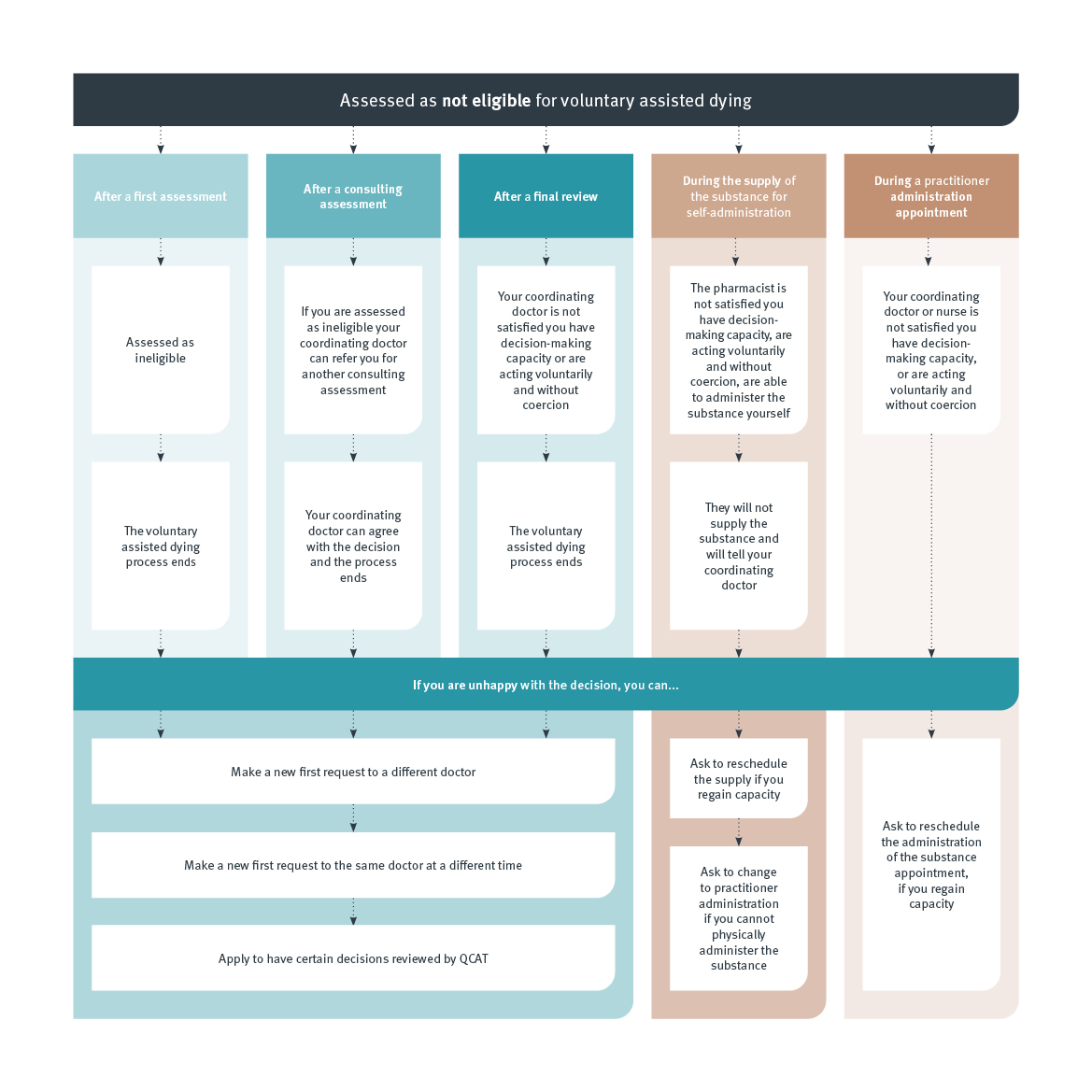
This flowchart gives a high-level overview of what you can do if you are assessed as ineligible at different points in the voluntary assisted dying process.
Before you make a first request
If you ask your doctor or healthcare team for information about voluntary assisted dying, they may tell you that you are unlikely to be eligible for voluntary assisted dying. This could be due to the fact that you:
- do not have a life-limiting disease, illness or medical condition
- are under the age of 18
- do not have decision-making capacity
- do not appear to be acting voluntarily or without coercion
- do not meet the residency requirements.
If this happens, your doctor or healthcare team will likely ask you follow up questions. This is to help you get the care, symptom management, information, counselling or support that you need.
It is important you are honest with your doctor or other healthcare worker about how this news makes you feel, so that they can help you get the support you need.
During the request and assessment process
Once you’ve made a first request and your doctor has accepted, your coordinating doctor can assess you as ineligible for voluntary assisted dying if they are not satisfied you:
- meet all the eligibility criteria
- understand the information given to you about voluntary assisted dying.
If your coordinating doctor assesses you as ineligible, the voluntary assisted dying process ends.
If you are assessed as ineligible
If your coordinating doctor decides that you are ineligible, they will:
- Explain why you are not eligible.
- If relevant, they may explain that your eligibility might change, if your circumstances change in the future. They may also explain that if your eligibility changes in the future, you may start the process again by making a new first request with them or a different doctor. For example, if your prognosis changes, you may become eligible for voluntary assisted dying at a later date.
- If the decision is reviewable by the Queensland Civil and Administrative Tribunal (QCAT), give you information about the decision, the reasons for the decision and your right to have the decision reviewed by QCAT.
- Give you a written copy of their decision.
Your coordinating doctor may also talk to you about other care and support available to you. This could include:
- discussing how your treating healthcare team may help ease any physical symptoms, psychological, social or spiritual distress you may be experiencing
- updating your care plan
- providing you with alternate referrals to relevant healthcare workers
- organising additional support from a specialist palliative care team (if one is not already involved in your care)
- discussing your ineligibility for voluntary assisted dying with other members of your healthcare team and family, if you do not want this to happen though they will respect your privacy.
What you can do
If your coordinating doctor assesses you as ineligible you can:
- make a new first request to a different doctor
- if your situation changes, make a new first request to the same doctor at a different time.
If you do this the voluntary assisted dying process will start from the beginning.
You can also apply to have certain decisions of the coordinating doctor reviewed by QCAT.
Your consulting doctor can assess you as ineligible for voluntary assisted dying if they are not satisfied you:
- meet all the eligibility criteria
- understand the information given to you about voluntary assisted dying.
If your consulting doctor assesses you as ineligible, your coordinating doctor may refer you to another doctor for another consulting assessment. There is no limit on the number of times this can happen. However, if your coordinating doctor does not think it is appropriate to refer you, the process ends.
If you are assessed as ineligible
If your consulting doctor decides that you are ineligible, they will:
- Explain why you are not eligible.
- If relevant, they may explain that your eligibility might change, if your circumstances change in the future and you may start the process again by making a new first request with them or a different doctor. For example, if your decision-making capacity changes, you may become eligible for voluntary assisted dying at a later date.
- If the decision is reviewable by QCAT, give you information about the decision, the reasons for the decision and your right to have the decision reviewed by QCAT.
- Give you a written copy of their decision.
Your consulting doctor will also talk to you about other care and support available to you. This could include:
- discussing how your treating healthcare team may help ease any physical symptoms, psychosocial or spiritual distress you may be experiencing
- updating your care plan
- providing you with alternate referrals to relevant healthcare workers
- organising additional support from a specialist palliative care team (if one is not already involved in your care)
- discussing your ineligibility for voluntary assisted dying with other members of your healthcare team and family—if you do not want this to happen, they will respect your privacy.
What you can do
If your coordinating doctor decides not to refer you for another consulting assessment you can:
- make a new first request to a different doctor
- if your situation changes, make a new first request to the same doctor at a different time.
If you do this the voluntary assisted dying process will start from the beginning.
You can also apply to have the decision reviewed by the QCAT.
Your coordinating doctor must confirm:
- the request and review process was completed correctly
- have decision-making capacity
- are acting voluntarily and without coercion.
If your coordinating doctor is not satisfied that the requirements of the final review have not been met, they will not move you onto the next stage.
Your coordinating doctor will:
- Explain their decision.
- If relevant, they may explain that your eligibility might change, if your circumstances change in the future and you may start the process again by making a new first request with them or a different doctor. For example, if your decision-making capacity changes, you may become eligible for voluntary assisted dying at a later date.
- If the decision is reviewable by QCAT, give you information about the decision, the reasons for the decision and your right to have the decision reviewed by QCAT.
- Give you a written copy of the final review form.
Your coordinating doctor will also talk to you about other care and support available to you. This could include:
- discussing how your treating healthcare team may help ease any physical symptoms, psychosocial or spiritual distress you may be experiencing
- updating your care plan
- providing you with alternate referrals to relevant healthcare workers
What you can do
If your coordinating doctor is not satisfied that you still have decision-making capacity and are acting voluntarily, you can:
- make a new first request to a different doctor
- if your situation changes, make a new first request to the same doctor at a different time.
If you do this the voluntary assisted dying process will start from the beginning.
You can also apply to have the decision reviewed by the QCAT.
After the final review
During the administration of the voluntary assisted dying substance stage of the process your coordinating doctor, a pharmacist employed by the Queensland Voluntary Assisted Dying Pharmacy Service (QVAD-Pharmacy), and administering doctor or nurse will check you still:
- have decision-making capacity; and
- are acting voluntarily and without coercion.
Decisions are not reviewable by QCAT after the request and assessment stage.
During supply of the substance for a self-administration decision
A pharmacist employed by the QVAD-Pharmacy will check during the supply of the substance for self-administration if you:
- have decision-making capacity
- are acting freely and voluntarily
- are able to administer the substance yourself.
If the pharmacist employed by QVAD-Pharmacy believes you do not meet one of these items, they will not supply you with the voluntary assisted dying substance. The pharmacist will tell your coordinating doctor that they have not supplied you with the substance.
What you can do
If a pharmacist employed by QVAD-Pharmacy does not supply you with the substance for a self-administration decision, you can:
- ask to reschedule the supply of the substance if you regain capacity
- ask your coordinating doctor if you can cancel your self-administration decision and change to a practitioner administration decision if you cannot physically administer the substance.
During a practitioner administration appointment
Your administering doctor or nurse will check if you:
- have decision-making capacity
- are acting voluntarily and without coercion.
If your administering doctor or nurse is not satisfied you have these, they will not administer you the substance.
Your coordinating doctor, or administering doctor or nurse will talk to you about other care and support available to you, this could include:
- discussing how your treating healthcare team may help ease any physical symptoms, psychosocial or spiritual distress you may be experiencing
- updating your care plan
- providing you with alternate referrals to relevant healthcare workers
- organising additional support from a specialist palliative care team (if one is not already involved in your care)
- discussing their decision with other members of your healthcare team and family—however, if you do not want this to happen, they will respect your privacy.
What you can do
If your administering doctor or nurse does not administer you the substance, you can ask to reschedule the administration of the substance for another time if you regain capacity.