
Browsing ant
Alert
Be on the lookout for browsing ants and report any sightings immediately.
Reporting options
- Report online.
- Phone Biosecurity Queensland on 13 25 23.
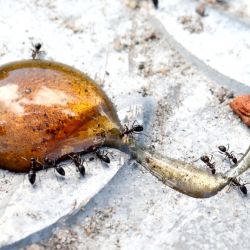
Browsing ants feeding on sugar syrup
© Queensland Government
Browsing ants originated in the drier climates of Southern Europe and the Mediterranean. An infestation detected at the Port of Brisbane in 2019 has been eradicated. In both Western Australia and the Northern Territory, browsing ants are subject to eradication programs.
Globally, not a lot is known about browsing ants; however, they share traits and behaviours with other well-known invasive ants such as yellow crazy ants and red imported fire ants.
Browsing ants pose no threat to human health.
A single browsing ant colony can support many queens, making them able to form super colonies, which can seriously impact the surrounding native flora and fauna.
Scientific name
Similar species
- Black crazy ant
Description
- Small and slender.
- Shiny black.
- 3–4mm long.
- Long antennae.
- Long legs.
- Body is tapered from the head to the abdomen.
- Move in a similar manner to other known 'crazy ants', occasionally jerking as they walk across the ground.
Habitat
- Prefer dry climates.
- Adapt to the local landscape.
- Do not build any obvious nest. They simply move into a space or cavity where they tend to the colony's eggs and larvae.
- They have been found nesting in:
- dry organic matter
- piles of building rubble
- gardens
- structures
- cavities in buildings
- utilities pits.
Distribution
- Native range is drier climates of Southern Europe and the Mediterranean.
- Current range is extensive, from Portugal west through parts of the Mediterranean, northern Africa, the Middle East and India.
- Commonly found in:
- Timor Leste
- Malaysia
- Occur in:
- Guam (eradicated)
- Hawaii
- the Northern Territory and Western Australia (under eradication)
- the Port of Brisbane (eradicated).
Life cycle
Browsing ants can form multi-queened super colonies.
Fertile queens can:
- bud off from the original colony
- quickly form dense populations
- establish super colonies where they eat other ants and compete for food and resources.
Worker ants will forage up trees and up to 50m from the nest.
Impacts
Environmental
- Omnivorous—eat other ants and insects, spiders, centipedes and crustaceans.
- Significantly affect our native biodiversity, either through predation or by competing with native animals.
- Super colonies can:
- displace important local ant species
- harm native vegetation
- disrupt ecosystems.
Economic
- Protect honeydew-producing scale insects, mealybugs and aphids, and feed on the honeydew as a reward. These insects reduce plant health and can spread serious disease, impacting agricultural and horticultural plants.
Social
- Don't sting or produce venom.
- Cause no recorded human health impacts, making them less obvious in human interactions than other invasive ant species.
- Forage and nest in rubbish receptacles and outdoor areas such as:
- yards
- gardens
- public parks
- reserves
- irrigation points.
Control
Before undertaking any preventative or control actions, contact us online, by phone or in person.
Check and report
- You can do your part to stop their spread. Check machinery, equipment, pot plants and other sources of soil before you move them.
- If you suspect browsing ant, restrict movement of any cargo, materials or equipment.
Legal requirements
The browsing ant is a prohibited invasive ant under the Biosecurity Act 2014. You must not:
- keep it
- move it
- give it away
- sell it
- release it into the environment.
If you do any of these, penalties may apply.
You must not take any action that is reasonably likely to exacerbate the biosecurity threat posed by browsing ants.
You must take any action that is reasonably likely to minimise the biosecurity threat posed by browsing ants.
You must report any sightings immediately using 1 of these methods:
- Report online.
- Phone Biosecurity Queensland on 13 25 23.
Further information
- Contact us online, by phone or in person.
- Read the browsing ants fact sheet.